

How to get from Kochkor to Song Kol Lake

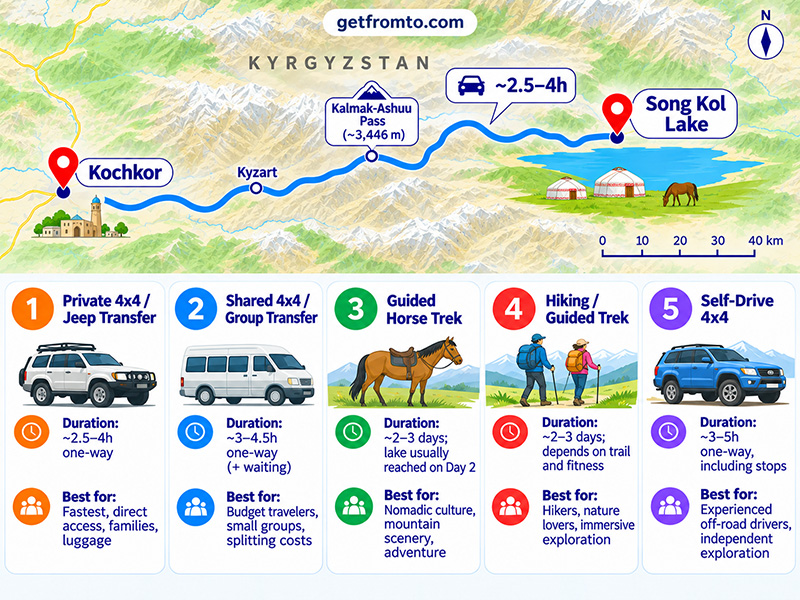
Traveling from Kochkor to Song Kol Lake takes you into Kyrgyzstan’s spectacular high-altitude pastures, where traditional yurts overlook a remote alpine lake. You can reach the lake by private 4×4, shared transfer, horseback trek, or hiking adventure. This guide covers routes, travel times, estimated costs, booking options, and essential tips for visiting Song Kol during the summer season.
At A Glance (Kochkor to Song Kol Lake)
| Mode | Duration | Best For |
|---|---|---|
| 🚙 Private 4×4 / Jeep Transfer (via Kalmak-Ashuu Pass) | ~2.5–4h one-way | Fastest, direct access, families, luggage |
| 🏷️ Cost: ~KGS 5,000–13,000 per vehicle one-way, depending on operator and arrangements » request local transfer | ||
| 🚐 Shared 4×4 / Group Transfer | ~3–4.5h one-way (+ waiting) | Budget travelers, small groups, splitting costs |
| 🏷️ Cost: ~KGS 1,300–3,500 per person when sharing a vehicle; availability and price depend on group size » ask about shared departures | ||
| 🐎 Guided Horse Trek (via Kyzart and Kilemche) | ~2–3 days; lake usually reached on Day 2 | Nomadic culture, mountain scenery, adventure |
| 🏷️ Cost: ~KGS 13,000–20,000 per person for a typical locally arranged 3-day trek; premium packages cost more » horse trekking arrangements | ||
| 🥾 Hiking / Guided Trek (via Kyzart) | ~2–3 days; depends on trail and fitness | Hikers, nature lovers, immersive exploration |
| 🏷️ Cost: Kochkor–Kyzart shared taxi ~KGS 200–500 pp; guided multi-day hiking packages often US$300+ pp, depending on inclusions » guided trekking details | ||
| 🚗 Self-Drive 4×4 (via Kalmak-Ashuu Pass) | ~3–5h one-way, including stops | Experienced off-road drivers, independent exploration |
| 🏷️ Cost: ~US$70–150+ per day for a suitable rental 4×4, plus fuel, deposits, and any insurance or recovery costs » compare rental cars | ||
Which Option or Route Should You Choose?
- Fastest / Most Convenient: Choose a private 4×4 transfer from Kochkor via Kalmak-Ashuu Pass. It takes approximately 2.5–4 hours, depending on the road and your yurt camp’s location.
- Cheapest / Most Economical: A shared 4×4 transfer is usually the best-value motorized option. Splitting the vehicle cost with three to five other travelers can significantly reduce your fare.
- Most Scenic / Cultural Experience: Book a guided horseback trek from Kyzart via Kilemche Valley. It combines mountain passes, traditional Kyrgyz horsemanship, and overnight stays in yurts.
- Best for Outdoor Adventure: A guided hiking trek offers a slower journey through alpine meadows, river valleys, and high mountain passes.
- Most Flexible Schedule: Self-driving a suitable 4×4 allows independent stops for photography and sightseeing, but requires mountain-driving experience and reliable road information.
- Best for a Short Visit: A private 4×4 can reach Song Kol on the same day, although spending at least one night in a lakeside yurt is strongly recommended.
How to Book and Practical Tips
- Best travel season: July and August are generally the most reliable months. Seasonal camps usually operate from approximately mid-June to mid-September, although road openings and closures depend on snow and weather.
- Arrange transportation in Kochkor: Contact CBT Kochkor, a local guesthouse, or a regional tour operator for 4×4 transfers, horse treks, guides, and yurt accommodation.
- Confirm the exact destination: Song Kol Lake has several widely separated yurt camps. Ask your operator to confirm the camp name, shoreline location, access road, and whether the final transfer is included.
- Carry Kyrgyz som: Bring enough cash for transportation, accommodation, meals, horse riding, and emergencies. There are no reliable ATM facilities at the lake.
- Prepare for high altitude: Song Kol sits around 3,016 meters above sea level. Spend time acclimatizing, drink water, avoid strenuous activity immediately after arrival, and descend if altitude sickness symptoms worsen.
- Pack warm clothing: Nights can approach or fall below freezing even in summer. Bring insulated layers, rain protection, sturdy footwear, sunscreen, and a flashlight.
- Download offline maps: Mobile coverage around the lake and on the approach roads is unreliable. Save maps, accommodation details, and your return arrangements before leaving Kochkor.
- Confirm the return journey: There are no regular buses from the lakeshore. Arrange a return pickup or onward transfer in advance, and allow extra time for weather delays.
🚙 Option 1 — Private 4×4 / Jeep Transfer (Fastest and Most Convenient)
Direct transfer Best for families Seasonal mountain road
- Overview: A private 4×4 is the easiest way to travel directly from Kochkor to Song Kol Lake. The journey commonly takes 2.5–4 hours, covering roughly 90–110 km depending on the selected camp and route. The usual approach follows the road through Sary-Bulak and over Kalmak-Ashuu Pass, at approximately 3,446 meters, before descending toward the lake’s eastern or northern shores.
- How to book (with price): Arrange a private jeep through CBT Kochkor, your Kochkor guesthouse, or a local driver. Budget approximately KGS 5,000–13,000 per vehicle one-way, although some operators quote higher rates for private tours. Confirm whether the quote covers one-way transport, a round trip, waiting time, or an overnight driver stay. You can also request a customized quote through GetTransfer, but specialist mountain transfers are not guaranteed to be listed.
- Route: Kochkor → Sary-Bulak area → Kalmak-Ashuu Pass → Song Kol Lake → designated yurt camp.
- Road conditions: The route combines paved sections, gravel roads, steep mountain climbs, and potentially muddy or rocky tracks. A locally operated high-clearance 4×4 is recommended, particularly after rainfall.
- Pros: Direct journey, comfortable luggage transport, flexible departure time, convenient for families, and the possibility of stopping at viewpoints.
- Cons: Higher cost for solo travelers; roads can become difficult or inaccessible during bad weather; pickup and return arrangements must be agreed in advance.
Step-by-step: Private 4×4 Transfer
- Arrange your driver: Contact CBT Kochkor, a local tour company, or your guesthouse at least one day before departure. For July and August, booking several days ahead is advisable.
- Confirm your accommodation: Reserve a yurt camp at Song Kol and give its name and location to the driver. Camps are spread around the shoreline, and reaching the wrong side can add considerable driving time.
- Meet your driver in Kochkor: Request pickup from your accommodation or a central meeting point. Departing around 8:00–9:00 AM provides daylight for mountain driving and sightseeing.
- Travel toward Sary-Bulak: Leave Kochkor on the approach roads toward the Kalmak-Ashuu route. Check that the driver has confirmed the pass is open.
- Cross Kalmak-Ashuu Pass: Climb through mountain valleys and high grasslands. Ask the driver to stop at safe viewpoints if conditions allow.
- Descend to Song Kol: Continue along the rough mountain road toward the lake. Travel may slow substantially in wet conditions.
- Arrive at your yurt camp: Check in with your host family, confirm your meals, and arrange your return pickup before the driver leaves.
Getting to the main departure points (Kochkor Town Center / Guesthouses)
- Kochkor town center: Most private 4×4 departures can be arranged from the central area, CBT office, or a nearby guesthouse.
- From your accommodation: Ask for direct pickup, especially if carrying large bags or traveling with children.
- From Kochkor bus stops: If arriving from Bishkek, Balykchy, or Naryn, arrange to meet your driver near the town’s main transport pickup area.
- Local alternatives: Private taxis may be available in Kochkor, but not every driver has a suitable vehicle or experience with Song Kol’s mountain roads. Do not rely on a ride-hailing app for the lakeshore journey.
- Locations/Trip Planner: 🔗 Google Map / 🔗 OpenStreetMap (Kochkor → Kalmak-Ashuu approach → Song Kol shore; final camp road and pass availability must be checked locally).
🚐 Option 2 — Shared 4×4 / Group Transfer (Best Value)
Lower cost Group friendly Availability-dependent
- Overview: Sharing a 4×4 with other travelers is often the most economical way to reach Song Kol without hiking or horseback riding. This is generally an arranged group transfer rather than a scheduled public service. The driving journey takes approximately 3–4.5 hours, with extra waiting time if passengers must be gathered.
- How to book (with price): Ask CBT Kochkor or local guesthouses about travelers visiting the lake on the same day. For a vehicle costing approximately KGS 5,000–13,000, splitting the fare among four passengers works out to about KGS 1,250–3,250 each. Budget roughly KGS 1,300–3,500 per person as a planning range. An available shared seat is not guaranteed.
- Route: Most shared road transfers follow the same Kalmak-Ashuu approach used by private jeeps, although the driver may choose another open route depending on conditions.
- Departure times: Group departures are typically coordinated in advance or arranged locally. There is no dependable daily public 4×4 timetable to the lakeshore.
- Pros: Lower individual cost, straightforward transportation, opportunities to meet other travelers, and less physical effort than trekking.
- Cons: Departure may depend on finding enough passengers; limited luggage space; less flexibility for stops; travelers may be staying at different camps.
Step-by-step: Shared 4×4 Transfer
- Ask about available groups: Visit CBT Kochkor, contact nearby hostels, or speak with your guesthouse about travelers heading to Song Kol.
- Compare group arrangements: Confirm how many people are sharing the vehicle, the exact cost per passenger, and whether the driver will drop everyone at their individual yurt camps.
- Reserve your seat: Agree on the meeting location, departure time, luggage allowance, and payment terms.
- Meet in central Kochkor: Arrive at the agreed pickup point with water, snacks, cash, and warm clothing.
- Drive over the mountain pass: Travel with the group toward Song Kol, with stops depending on the driver’s schedule.
- Reach the designated drop-off: Confirm that your yurt camp is within the agreed route. Otherwise, arrange a separate final transfer with your host.
- Organize the return: Ask whether the group plans to return together or whether you need a separately booked pickup.
Getting to the main departure points (CBT Kochkor / Central Guesthouses)
- CBT Kochkor: The local community-tourism office is a practical starting point for asking about shared vehicles and group tours.
- Central guesthouses and hostels: Many independent travelers arrange car-sharing through accommodation hosts. Ask whether other guests have matching dates.
- Kochkor town center: Shared transfers often depart from an agreed central meeting point rather than a formal bus platform.
- Public transport limitation: There is no regular marshrutka or public bus from Kochkor directly to Song Kol Lake. A locally arranged shared vehicle should not be confused with a scheduled service.
- Locations/Trip Planner: 🔗 Google Map / 🔗 OpenStreetMap (indicative driving route; actual group drop-off depends on the camp).
🐎 Option 3 — Guided Horse Trek via Kyzart and Kilemche (Most Scenic and Cultural)
Traditional experience Spectacular scenery 2–3 days
- Overview: Horseback trekking is one of the most memorable ways to reach Song Kol. A popular route begins with a road transfer from Kochkor to Kyzart village, approximately 70 km away, then continues through Kilemche Valley and over a high mountain pass into the Song Kol basin. Typical organized itineraries last 3 days and 2 nights, reaching the lake on the second day before returning to Kyzart or continuing by vehicle.
- How to book (with price): Contact CBT Kochkor for horse-trekking arrangements. Locally organized 3-day treks commonly cost approximately KGS 13,000–20,000 per person, while more comprehensive private or English-guided packages can be significantly more expensive. Ask whether horse rental, guide, accommodation, meals, luggage transport, and the Kochkor–Kyzart transfer are included.
- Typical route: Kochkor → Kyzart village → Kilemche Valley → Jalgyz-Karagai Pass area → Song Kol Lake → return through a designated mountain trail.
- Travel duration: Expect approximately 4–6 hours of riding per trekking day, although terrain, weather, group experience, and route selection affect the schedule.
- Experience required: Beginner-friendly guided trips are available, but riders should be reasonably fit and comfortable spending several hours in the saddle. Request a gentle horse and appropriate safety equipment.
- Pros: Excellent mountain scenery, close contact with traditional nomadic life, access to remote valleys, and memorable yurt accommodation.
- Cons: Longer journey, exposure to changing mountain weather, physical fatigue, and higher package costs than shared road transport.
Step-by-step: Guided Horse Trek
- Book the trek in Kochkor: Contact CBT Kochkor or a local trekking organizer. Choose a 2-day or 3-day itinerary and confirm the riding difficulty, route, accommodation, and included services.
- Transfer to Kyzart: Travel approximately 1–1.5 hours from Kochkor to Kyzart village by arranged vehicle. Many complete tour packages include this transfer.
- Meet your guide and horses: Receive basic riding instructions, adjust your saddle, organize luggage, and discuss the route with your guide.
- Day 1 — Ride toward Kilemche Valley: Follow scenic trails through open grasslands and mountain pastures, generally riding for several hours before reaching a seasonal yurt camp.
- Overnight in Kilemche: Enjoy a traditional Kyrgyz meal and sleep in a yurt. Facilities are basic, and temperatures may become very cold overnight.
- Day 2 — Cross the mountain pass: Continue toward the Song Kol basin, climbing to approximately 3,300–3,400 meters depending on the selected route. Descend toward the lake and arrive at your next yurt camp.
- Explore Song Kol: Spend the afternoon enjoying the shoreline, mountain scenery, and nomadic atmosphere. Optional short rides may be available.
- Day 3 — Return to Kyzart or Kochkor: Complete the return ride over the route specified by your operator, then take the arranged vehicle back to Kochkor. Some itineraries instead include a vehicle pickup at the lake.
Getting to the main departure points (Kyzart Village / Horse Trek Trailheads)
- From Kochkor to Kyzart: Take a prearranged taxi or shared car toward Kyzart, approximately 70 km from Kochkor. A shared seat may cost around KGS 200–500, although availability varies.
- From Kochkor guesthouses: Many trekking packages include pickup at your accommodation and transportation directly to the village or trailhead.
- Kyzart village: Local homestays and trekking guides organize horses and riding routes. Confirm whether your trek starts in the village itself or at a separate trailhead near Kyzart Pass.
- Trail access: Horse trekking paths are not ordinary vehicle roads. Meet your guide at the agreed starting point rather than attempting to follow car-navigation directions into the mountains.
- Locations/Trip Planner: 🔗 Google Map / 🔗 OpenStreetMap (Kochkor → Kyzart road approach; Kilemche and Song Kol are reached on guided horse trails).
🥾 Option 4 — Hiking / Guided Trek via Kyzart (Best for Nature and Adventure)
Outdoor adventure Mountain landscapes Moderate to challenging
- Overview: Hiking from the Kyzart area to Song Kol offers a rewarding journey through alpine meadows, shepherd settlements, and high mountain passes. A common itinerary follows Kyzart → Kilemche → Song Kol, with a return route or arranged vehicle pickup. Allow approximately 2–3 days, or longer for a relaxed pace.
- How to book (with price): Arrange a guide through CBT Kochkor or examine the 3-day Song Kol trekking itinerary offered by Visit Kyrgyzstan. Published fully organized 2026 hiking packages start around US$300 per person for larger groups and cost more for smaller groups. Independent hikers can reduce costs substantially by arranging transportation, food, and yurt stays separately, but must be properly equipped and capable of mountain navigation.
- Approach transport: Travel from Kochkor to Kyzart by taxi or arranged transfer, usually about 1–1.5 hours. A shared taxi seat can cost approximately KGS 200–500 where available.
- Trail conditions: Routes cross uneven terrain, steep slopes, exposed passes, and potentially wet or muddy grasslands. Snow can remain at higher elevations in early summer.
- Accommodation: Guided itineraries commonly use seasonal yurts in Kilemche and at Song Kol. Independent camping is possible where permitted, but requires weather-appropriate equipment and responsible campsite selection.
- Pros: Excellent scenery, immersive outdoor experience, flexible walking pace, wildlife-watching opportunities, and access to remote places.
- Cons: Physically demanding, weather-dependent, limited emergency access, and potentially confusing navigation in poor visibility.
Step-by-step: Hiking to Song Kol Lake
- Choose your hiking itinerary: Select a guided 3-day Kyzart–Kilemche–Song Kol route or plan a longer trek if traveling independently.
- Arrange your equipment: Bring waterproof hiking boots, warm layers, rain protection, navigation tools, water purification equipment, first-aid supplies, and suitable overnight gear.
- Travel from Kochkor to Kyzart: Take a local taxi or booked transfer to your designated trailhead. Confirm the pickup location and return arrangements before beginning.
- Day 1 — Hike to Kilemche: Walk through rolling mountain pastures and valleys, typically covering approximately 13 km on common guided itineraries. Overnight at an available yurt camp.
- Day 2 — Cross toward Song Kol: Climb toward the Jalgyz-Karagai Pass area, with elevations approaching 3,400 meters. Descend into the Song Kol basin and continue toward your lakeside accommodation.
- Explore the lakeshore: Rest, photograph the landscape, and visit your host family’s yurt camp. Avoid overexertion if you experience altitude-related discomfort.
- Day 3 — Return or connect with transport: Follow the return hiking route to Kyzart or meet an arranged 4×4 at a confirmed lakeside pickup point.
Getting to the main departure points (Kyzart / Kilemche Trailheads)
- Kochkor to Kyzart: Arrange a shared or private taxi through your accommodation or local transportation contacts.
- Kyzart village: The village is a common organizing base for guided treks, homestays, and departures toward the Kilemche Valley.
- Trailhead transfer: Some tours begin walking from a point outside Kyzart village. Ask your guide exactly where the hike starts and whether additional road transportation is provided.
- Independent hikers: Download offline trail maps and carry backup navigation, but do not assume every mapped path is passable. Ask local guides about seasonal stream crossings, snow, and safe overnight locations.
- Locations/Trip Planner: 🔗 Google Map / 🔗 OpenStreetMap (Kochkor → Kyzart by road, followed by the Kilemche → Song Kol hiking trail; obtain the actual trek route from your guide).
🚗 Option 5 — Self-Drive 4×4 via Kalmak-Ashuu Pass (Most Flexible)
Flexible schedule Photography stops Off-road experience required
- Overview: Renting a suitable 4×4 allows travelers to drive independently from Kochkor to Song Kol Lake, stopping along the way for mountain views and photography. The Kalmak-Ashuu route is a common approach, although actual road conditions determine which entrance is practical. Expect approximately 3–5 hours of driving and stops.
- How to book (with price): Search for a suitable high-clearance rental vehicle through Booking.com Car Rentals or a Kyrgyzstan-based 4×4 specialist. A planning budget is approximately US$70–150+ per day for an appropriate off-road-capable vehicle, excluding fuel and possible extras. Rental prices and availability vary, and many standard rental agreements prohibit driving on unpaved mountain roads. Confirm written permission and insurance coverage before booking.
- Suggested route: Kochkor → Sary-Bulak area → Kalmak-Ashuu Pass → Song Kol Lake. Confirm that your selected yurt camp is accessible from this approach.
- Road conditions: Expect sections of loose gravel, steep gradients, potholes, ruts, and potentially slippery or muddy mountain tracks. Rain or snow can make driving significantly more difficult.
- Vehicle requirements: Choose a reliable, high-clearance 4×4 with good tires and a usable spare. Check the brakes, fuel range, recovery equipment, and rental roadside-assistance arrangements.
- Pros: Maximum flexibility, independent sightseeing stops, no need to wait for a group, and easier photography and luggage transport.
- Cons: Road hazards, limited assistance, possible rental restrictions, higher responsibility for breakdowns, and navigation challenges.
Step-by-step: Self-Drive 4×4
- Rent a suitable vehicle: Arrange a high-clearance 4×4 in Bishkek or another available rental location. Confirm that the company permits travel on Song Kol’s unpaved mountain routes.
- Reach Kochkor: Drive to Kochkor and use the town as your last major preparation stop before entering the mountains.
- Check road access: Ask your accommodation, CBT Kochkor, or local drivers whether Kalmak-Ashuu Pass is open and suitable for your vehicle.
- Prepare in Kochkor: Fill the fuel tank, withdraw cash, purchase food and water, and download offline navigation maps.
- Drive toward Kalmak-Ashuu: Follow the confirmed mountain approach from Kochkor, slowing down on gravel and steep sections. Avoid driving after dark.
- Cross the pass carefully: Watch for loose stones, livestock, narrow road edges, and sudden weather changes. Stop only where the vehicle can safely leave the roadway.
- Continue to the lake: Navigate toward the exact yurt camp rather than using only the lake’s central map pin.
- Park and arrange your stay: Follow your host’s parking instructions, respect grazing land, and confirm the return route before leaving the camp.
Getting to the main departure points (Kochkor / Rental Pickup Locations)
- Bishkek: Usually offers more rental choices than Kochkor. Reserve your 4×4 ahead of time and confirm whether driving to Song Kol is permitted.
- Kochkor town center: The practical staging point for fuel, groceries, local road information, and last-minute equipment checks.
- Sary-Bulak approach: Follow the confirmed road toward Kalmak-Ashuu rather than attempting shortcuts suggested by ordinary navigation apps.
- Song Kol lakeshore: Vehicle access varies by camp and road conditions. Ask the host for precise coordinates and the recommended approach.
- Locations/Trip Planner: 🔗 Google Map / 🔗 OpenStreetMap (indicative route via Kalmak-Ashuu; the mapped endpoint is a shoreline approach, not a confirmed camp or guaranteed passable road).
FAQ (Kochkor to Song Kol Lake)
1. How far is Song Kol Lake from Kochkor, and how long does it take?
The driving distance is roughly 90–110 km, depending on the approach road and chosen yurt camp. A private 4×4 usually takes approximately 2.5–4 hours one-way, although mountain weather, road conditions, and sightseeing stops can extend the journey. Horse riding and hiking itineraries generally require 2–3 days.
2. Is there a public bus or marshrutka from Kochkor to Song Kol Lake?
No regular public bus or marshrutka operates directly to Song Kol Lake. Travelers generally hire a private 4×4, join an arranged group transfer, or travel toward Kyzart to begin a guided trek. Shared taxis may serve Kyzart, but they do not provide regular onward service to the lakeshore.
3. What is the cheapest way to get from Kochkor to Song Kol Lake?
Sharing a 4×4 with other travelers is usually the cheapest practical option for reaching the lake directly without hiking. A shared vehicle may cost around KGS 1,300–3,500 per person, depending on passenger numbers and the driver’s total fare. Budget-conscious hikers can also take a shared taxi to Kyzart and walk, provided they have suitable experience, equipment, and a safe route.
4. When is the best time to visit Song Kol Lake?
July and August generally offer the most dependable combination of accessible mountain roads, operating yurt camps, and available local guides. Mid-June through mid-September is the usual tourist season, but opening and closing dates vary with snow and weather. Travel in November through spring is not a normal road-based tourist option because high passes and camps are generally closed.
5. Can I visit Song Kol Lake as a day trip from Kochkor?
Yes, a day trip is possible by private 4×4 when the mountain roads are open. Allow approximately 5–8 hours for the round-trip drive, plus time at the lake. However, a one-night stay is preferable because it provides more time for lakeside walks, sunset photography, horseback riding, and traditional yurt hospitality.
6. Do I need to book a yurt camp in advance, and are there hotels at Song Kol?
Song Kol mainly offers seasonal yurt accommodation rather than conventional hotels. Booking ahead is recommended in July and August, especially for families or travelers requiring specific sleeping arrangements. CBT Kochkor and local camp operators can help arrange accommodation, meals, and transport. Facilities are basic, and electricity, showers, mobile coverage, and electronic payments may be unavailable. Confirm all inclusions before arrival.


Related Tours/Services
Popular Routes
Recent Routes
- How to get from Piraeus Cruise Terminal to Athens International Airport
- How to get from Dubai Port Rashid Cruise Terminal to Dubai International Airport
- How to get from Dushanbe to Penjikent
- How to get from Kochkor to Song Kol Lake
- How to get from Naryn to At-Bashy
- How to get from Turkistan to Shymkent
- How to get from Halifax Stanfield Airport to Downtown Halifax
- How to get from Winnipeg Richardson Airport to Downtown Winnipeg
- How to get from Kelowna International Airport to Downtown Kelowna
- How to get from Victoria International Airport to Downtown Victoria
Top Travel Gears

travel inspira Luggage Scale Digital Suitcase Weight Scale for Travel | Blue Backlight, Rubber Paint Handle, Tare & Data Lock, Auto-Off, Battery Included, 110 Pounds, Travel Essentials

INIU 10000mAh 45W Fast Charging Portable Charger, Smaller Travel Power Bank | Flight-Safe, Detachable USB C Cable, Travel Essential, External Battery Phone Pack for iPhone 18 17 Samsung iPad etc

LISEN Airplane Travel Essentials for Flying Airplane Phone Holder for Desk Phone Stand Hands Free MagSafe Travel Accessories Long Flight Flying Italy Travels Must Haves Travel Tech Gifts for Men

FYY Electronic Organizer, Travel Tech Pouch Bag, Cable Organizer Black | Wrist Strap, Waterproof, Double Layers Portable Electronics Travel Carrying Case for Cord, Charger, Daily Business Trips Use

2026 Travel Essentials for Apple Watch Charger,Cruise Vacation Camping Essentials,iPhone Charger,Multi Charging Cable,3 in 2 Charging Docks for iWatch Series 12 11-2/Ultra,iPhone 18 17-12,Car
