

How to get from Cape Town to Cape of Good Hope

Cape Town to the Cape of Good Hope is one of South Africa’s most scenic day trips, featuring dramatic coastlines, mountain passes, wildlife, and ocean viewpoints. Located at the southern end of the Cape Peninsula, the destination is accessible by rental car, guided tour, sightseeing coach, or private transfer. This guide covers routes, travel times, costs, and practical tips.
At A Glance (Cape Town to Cape of Good Hope)
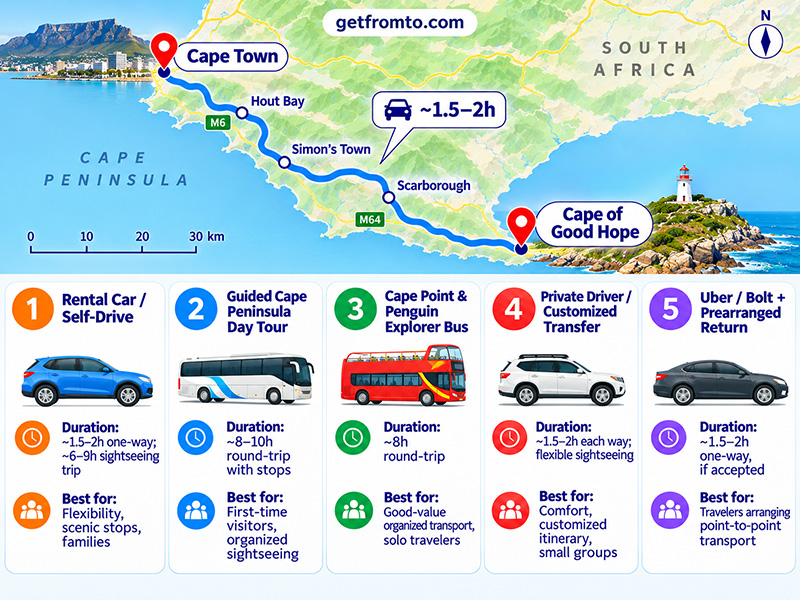
| Mode | Duration | Best For |
|---|---|---|
| 🚗 Rental Car / Self-Drive | ~1.5–2h one-way; ~6–9h sightseeing trip | Flexibility, scenic stops, families |
| 🏷️ Cost: ~ZAR 400–900/day rental + fuel, optional toll, and park entry » compare rental cars | ||
| 🚌 Guided Cape Peninsula Day Tour | ~8–10h round-trip with stops | First-time visitors, organized sightseeing |
| 🏷️ Cost: ~ZAR 650–1,500 pp for group tours; park entry may be extra » compare day tours | ||
| 🚍 Cape Point & Penguin Explorer Bus | ~8h round-trip | Good-value organized transport, solo travelers |
| 🏷️ Cost: ~ZAR 475–600 pp base ticket; park entry extra unless included in ticket option » official bus tickets | ||
| 🚕 Private Driver / Customized Transfer | ~1.5–2h each way; flexible sightseeing | Comfort, customized itinerary, small groups |
| 🏷️ Cost: ~ZAR 1,800–4,000+ per vehicle for a prearranged return journey; entry usually extra » request transfer quotes | ||
| 🚖 Uber / Bolt + Prearranged Return | ~1.5–2h one-way, if accepted | Travelers arranging point-to-point transport |
| 🏷️ Cost: Allow ~ZAR 800–1,500+ one-way as a planning estimate; actual app quotes vary and return availability is uncertain | ||
Which Option or Route Should You Choose?
- Most flexible and scenic: A rental car is ideal if you want to explore Chapman’s Peak Drive, Hout Bay, Cape Point, Boulders Beach, and Simon’s Town at your own pace. It can also be economical when several travelers share the rental cost.
- Best for first-time visitors: A guided Cape Peninsula day tour provides organized transport, sightseeing stops, and local commentary without the stress of navigating unfamiliar roads.
- Best-value organized transport: The Cape Point & Penguin Explorer Bus is a practical choice for solo travelers or couples wanting a scheduled excursion with major attractions included in the itinerary.
- Most comfortable: A private driver or customized transfer offers hotel pickup, flexible stops, and a confirmed return journey, making it particularly convenient for families and groups.
- Best for a simple one-way journey: Uber or Bolt may provide transport from Cape Town, but acceptance of long-distance trips is uncertain, and finding another ride from Cape Point can be difficult. Arrange the return before leaving.
- Best coastal driving route: Travel south through Camps Bay, Hout Bay, Chapman’s Peak Drive, Noordhoek, and Scarborough for dramatic Atlantic Ocean views. This route is particularly attractive in clear weather, but Chapman’s Peak is a toll road and may close during unsafe conditions.
- Best alternative route: Travel through Muizenberg, Kalk Bay, Fish Hoek, and Simon’s Town along the False Bay coast. This option works well if you also want to visit the African penguin colony at Boulders Beach.
How to Book and Practical Tips
- Budget for park entrance fees: The Cape of Good Hope is within Table Mountain National Park, operated by SANParks. For 1 November 2026–31 October 2027, standard international admission is ZAR 592 per adult and ZAR 288 per child aged 2–11. South African citizens/residents pay ZAR 115/57, while SADC nationals pay ZAR 242/124, subject to eligibility documents. Fees may change.
- Check opening hours: The reserve generally admits visitors from 6:00 AM–6:00 PM (October–March) and 7:00 AM–5:00 PM (April–September), with visitors required to leave by the posted closing time. Check the official Cape Point visitor information before departure.
- Allow a full day: Although the direct drive takes approximately 1.5–2 hours each way, scenic viewpoints, wildlife encounters, hiking, and optional visits to Boulders Beach can turn the journey into an 8–10-hour excursion.
- Check Chapman’s Peak Drive: The famous coastal road charges a toll and may close because of strong winds, rockfall, or maintenance. Confirm conditions through Chapman’s Peak Drive before choosing the western coastal route.
- Know the difference between Cape Point and the Cape of Good Hope: Cape Point is known for its lighthouse and viewing platforms, while the Cape of Good Hope has a separate coastal viewpoint and famous sign. Both are inside the same reserve, but reaching them involves different internal roads or walking trails.
- Do not rely on public buses: Cape Town’s regular MyCiTi buses and commuter trains do not provide direct transportation to the Cape of Good Hope reserve. Use a rental car, organized excursion, or prearranged driver for the final journey.
- Prepare for wind and wildlife: Bring a jacket, drinking water, sunscreen, and walking shoes. Keep food secured and never approach or feed baboons or other wildlife. Swimming at Diaz Beach is unsafe because of powerful currents.
- Arrange return transport: Mobile reception can be unreliable within the reserve, and Uber or Bolt drivers may not be available. If you are not self-driving or joining a return tour, organize your return transportation before entering.
🚗 Option 1 — Rental Car / Self-Drive (Most Flexible and Scenic)
Flexible schedule Scenic coastal route Park entry extra
- Overview: Driving from Cape Town to the Cape of Good Hope is one of the most rewarding day trips in the Western Cape. The journey covers approximately 65–80 km one-way depending on your starting point and route, with a typical driving time of 1.5–2 hours without lengthy stops. The Atlantic coastal route passes Camps Bay, Hout Bay, Chapman’s Peak Drive, Noordhoek, and Scarborough before reaching the Cape of Good Hope entrance. Alternatively, the False Bay route passes Muizenberg, Kalk Bay, Fish Hoek, and Simon’s Town. Once inside the reserve, allow additional driving time to reach Cape Point and the Cape of Good Hope viewpoints.
- How to book (with price): Compare Cape Town car rentals from city-center agencies or Cape Town International Airport. Economy vehicles commonly cost approximately ZAR 400–900 per day, depending on season, insurance, and rental conditions. Budget another ZAR 200–400 approximately for fuel on a longer peninsula sightseeing loop, plus the optional Chapman’s Peak toll and applicable SANParks entrance fees. Check SANParks for the latest conservation charges.
- Pros: Complete flexibility, numerous scenic stops, easy access to different reserve viewpoints, and good value when sharing the vehicle. Cons: Driving on the left, potential traffic congestion, parking considerations, toll costs, and responsibility for navigation.
Step-by-step: Rental Car via Chapman’s Peak Drive
- Collect your rental car: Pick up the vehicle from Cape Town International Airport, the city center, or another rental location. Confirm your license, insurance coverage, fuel policy, and any deposit requirements.
- Depart central Cape Town: Start from the City Bowl, V&A Waterfront, or your accommodation and head toward the Atlantic Seaboard.
- Drive through Camps Bay: Follow the coastal road south, enjoying views of the Twelve Apostles mountains and the Atlantic Ocean. Stop only in designated parking areas.
- Continue to Hout Bay: Travel through the coastal suburbs toward Hout Bay, where you can stop for breakfast, harbor views, or refreshments.
- Cross Chapman’s Peak Drive: Follow the scenic toll road toward Noordhoek if it is open. Allow additional time for designated viewpoints and photographs.
- Travel toward Scarborough: Continue through the southern peninsula, passing areas near Kommetjie and Scarborough on the way to the Cape of Good Hope reserve entrance.
- Enter Table Mountain National Park: Pay the conservation fee or present a valid ticket at the main gate. Keep proof of payment available while visiting.
- Visit the Cape of Good Hope: Follow the internal park road toward the Cape of Good Hope parking area and famous coastal sign. This is separate from the Cape Point lighthouse parking area.
- Continue to Cape Point: Drive to the Cape Point parking area, where you can hike uphill or take the Flying Dutchman Funicular toward the historic lighthouse viewpoint. The funicular requires a separate ticket.
- Return through Simon’s Town: For a scenic loop, drive north via Simon’s Town, Fish Hoek, Kalk Bay, and Muizenberg. You can optionally visit Boulders Beach, which has its own entrance fee.
Getting to the main departure points (Cape Town City Center / Rental Car Offices)
- Cape Town City Center: Rental companies operate around the CBD, Foreshore, and nearby commercial areas. Choose a pickup location convenient to your accommodation.
- V&A Waterfront: Some rental services offer nearby collection or vehicle delivery, making this a convenient starting point for visitors staying around the waterfront.
- Cape Town International Airport: Airport rental desks are useful for visitors collecting a vehicle immediately after arrival. The airport is east of the city, so allow extra travel time when planning the peninsula route.
- Atlantic coastal departure: From central Cape Town, navigate toward Camps Bay and Hout Bay before joining Chapman’s Peak Drive.
- False Bay alternative: If Chapman’s Peak is closed, use the inland or eastern peninsula roads through Simon’s Town and continue toward the reserve entrance.
- Locations/Trip Planner: 🔗 Google Map / 🔗 OpenStreetMap
🚌 Option 2 — Guided Cape Peninsula Day Tour (Best for First-Time Visitors)
Organized sightseeing Multiple attractions Fixed itinerary
- Overview: Guided Cape Peninsula tours are among the easiest ways to visit the Cape of Good Hope without renting a car. Most excursions depart central Cape Town in the morning and visit several locations along the peninsula, such as Camps Bay, Hout Bay, Chapman’s Peak Drive, Cape Point, the Cape of Good Hope, and Boulders Beach. Tours generally last 8–10 hours round-trip, depending on the route, traffic, and sightseeing stops.
- How to book (with price): Compare Cape Peninsula and Cape Point guided tours on GetYourGuide. Group excursions commonly start around ZAR 650–1,500 per person, while smaller-group and premium options cost more. Check whether the price includes park entrance, Boulders Beach admission, Chapman’s Peak tolls, and hotel pickup. Some tours charge these separately. You can also browse Cape Point sightseeing tour listings on Klook when available.
- Pros: Convenient transportation, knowledgeable guides, multiple attractions in one day, no need to drive, and suitable for solo travelers. Cons: Fixed schedules, limited time at individual viewpoints, possible group waiting times, and additional attraction fees on some tours.
Step-by-step: Guided Cape Peninsula Day Tour
- Select your preferred excursion: Choose between a standard large-group tour, a small-group excursion, or a premium guided itinerary. Check whether the Cape of Good Hope sign and Cape Point lighthouse are both included.
- Review the pickup arrangements: Many operators collect guests from hotels in central Cape Town, Sea Point, Green Point, and nearby tourist districts. Others use fixed meeting points.
- Confirm all additional charges: Before booking, check park entry, Boulders Beach fees, food, optional boat trips, and funicular tickets.
- Meet your guide in Cape Town: Arrive at the confirmed hotel pickup point or meeting location before the scheduled departure time.
- Travel along the Cape Peninsula: Depending on the itinerary, enjoy scenic coastal roads and photo stops around Hout Bay, Chapman’s Peak, or the False Bay coastline.
- Enter the Cape of Good Hope reserve: Continue through the national park gate and follow the guide’s instructions regarding tickets, stops, and the return meeting time.
- Explore Cape Point and the Cape of Good Hope: Visit the viewpoints, photograph the landmark sign, and enjoy a short walk or optional lighthouse excursion where the schedule allows.
- Visit other peninsula attractions: Some tours continue to Boulders Beach in Simon’s Town to see African penguins before returning toward Cape Town.
- Return to the city: The excursion normally finishes in the late afternoon or early evening at the original meeting location or designated hotel drop-off area.
Getting to the main embarking points (Cape Town Hotels / Central Meeting Points)
- V&A Waterfront: A common departure area for Cape Peninsula tours. Confirm the exact tour office or meeting point provided by your operator.
- Cape Town CBD: Many excursions collect visitors from central hotels or designated meeting areas near major streets.
- Sea Point and Green Point: Hotel pickup may be available depending on the tour company and booking package.
- Other Cape Town suburbs: If your accommodation is outside the pickup zone, arrange a short Uber, Bolt, or taxi ride to the assigned meeting point.
- Locations/Trip Planner: 🔗 Google Map / 🔗 OpenStreetMap
🚍 Option 3 — Cape Point & Penguin Explorer Bus (Best-Value Organized Transport)
Good value Central departure Scheduled tour
- Overview: The City Sightseeing Cape Point & Penguin Explorer Tour is a dedicated guided day excursion from Cape Town. Unlike the regular urban hop-on hop-off buses, this service travels into the Cape Peninsula and visits Cape Point, the Cape of Good Hope, and the Boulders Beach penguin area. The excursion takes approximately 8 hours and includes air-conditioned coach transportation and live English commentary.
- How to book (with price): Reserve through the official City Sightseeing Cape Point tours page. Base adult tickets are commonly advertised around ZAR 475–600, depending on the promotion and ticket option. The Cape Point conservation fee is normally additional unless you select a package that specifically includes it. Boulders Beach entrance, the funicular, and lunch are generally extra. Confirm the final ticket inclusions and current departure information before paying.
- Pros: Straightforward booking, recognized departure points, guided sightseeing, comfortable transport, and good value for travelers without a car. Cons: Fixed departure and return times, limited freedom to extend stops, and potentially significant additional entrance fees.
Step-by-step: Cape Point & Penguin Explorer Bus
- Book your tour: Visit the official City Sightseeing website and select your preferred date and ticket option.
- Choose your departure point: The operator commonly lists the V&A Waterfront tour office near the Two Oceans Aquarium and the CBD office at 81 Long Street. Confirm the departure location and time printed on your ticket.
- Arrive before departure: Reach the meeting point early with your booking confirmation, payment card, comfortable walking shoes, and a light jacket.
- Board the sightseeing coach: Follow the guide’s instructions as the bus leaves Cape Town toward the southern peninsula.
- Travel through scenic peninsula roads: The standard route may pass Ou Kaapse Weg, Kommetjie, and Scarborough before reaching Cape Point. Routes can change because of traffic or road conditions.
- Visit Cape Point: Spend time exploring the nature reserve, admiring ocean viewpoints, and optionally taking the Flying Dutchman Funicular toward the lighthouse.
- Continue to the Cape of Good Hope: The tour includes time at the famous landmark and may offer an optional guided walk between Cape Point and the Cape of Good Hope for travelers who are comfortable hiking.
- Stop at Boulders Beach: Continue to Simon’s Town to see the African penguin colony. Paid access to the protected viewing area requires a separate ticket unless included in your booking.
- Return to Cape Town: The excursion generally returns to the V&A Waterfront in the late afternoon, around 5:45 PM on the published standard itinerary. Confirm the current return time with the operator.
Getting to the main embarking points (V&A Waterfront / 81 Long Street)
- V&A Waterfront: The City Sightseeing tour office is located outside the Two Oceans Aquarium, close to the main waterfront visitor area.
- Cape Town CBD: The 81 Long Street office is a central alternative meeting point for travelers staying in the City Bowl.
- Sea Point and Green Point: Use a short taxi or ride-hailing trip to the Waterfront, or check whether complimentary collection from an eligible City Sightseeing stop is available.
- Accommodation outside the center: Allow extra time for morning traffic when traveling to the assigned departure point.
- Locations/Trip Planner: 🔗 Google Map / 🔗 OpenStreetMap
🚕 Option 4 — Private Driver / Customized Transfer (Most Comfortable)
Hotel pickup Custom itinerary Higher cost
- Overview: Hiring a private driver provides a flexible way to travel from Cape Town to the Cape of Good Hope without driving yourself. The direct journey generally takes 1.5–2 hours each way, while a complete peninsula sightseeing trip may last 6–9 hours or longer. Travelers can request stops at Chapman’s Peak, Hout Bay, Cape Point, Boulders Beach, and other attractions, depending on the driver’s availability and agreed schedule.
- How to book (with price): Request a private return-trip quotation through GetTransfer, ask your Cape Town hotel concierge, or contact a registered local transfer operator. A full or half-day customized vehicle service may cost approximately ZAR 1,800–4,000 or more per vehicle, depending on duration, vehicle category, number of stops, and waiting time. Confirm whether national park entrance, Chapman’s Peak tolls, parking, and driver expenses are included. International travelers can also explore Welcome Pickups in Cape Town for available prebooked transport services, although a customized Cape Point excursion may require a separate quotation.
- Pros: Door-to-door service, flexible timetable, confirmed return transportation, convenient with children or luggage, and personalized stops. Cons: Higher total cost, extra charges for extended waiting, and varying inclusions between operators.
Step-by-step: Private Driver / Customized Transfer
- Choose the type of service: Decide whether you want a direct return transfer to the Cape of Good Hope or a customized sightseeing day covering the Cape Peninsula.
- Request quotations: Provide your Cape Town pickup address, travel date, passenger count, preferred departure time, and desired sightseeing stops.
- Confirm the complete itinerary: Make sure the driver understands that you want to visit the Cape of Good Hope sign, not only the Cape Point lighthouse or main reserve gate.
- Check pricing details: Confirm how many hours are included, any overtime charges, road tolls, waiting time, park entry arrangements, and return drop-off location.
- Meet your driver: Start at your hotel, apartment, or another agreed pickup point in central Cape Town.
- Travel south through the peninsula: Choose between the Atlantic coastal route through Hout Bay and Chapman’s Peak or the False Bay route through Simon’s Town.
- Explore Cape Point and the Cape of Good Hope: Visit both locations within the reserve and arrange a convenient pickup time after each stop.
- Add optional attractions: Depending on the agreed schedule, stop at Boulders Beach, Kalk Bay, or Hout Bay for sightseeing and refreshments.
- Return to Cape Town: Your driver takes you directly back to your accommodation or another prearranged drop-off point.
Getting to the main pickup points (Cape Town Hotels / Airport / Waterfront)
- Cape Town CBD: Private drivers can generally collect passengers directly from hotels and apartments with suitable vehicle access.
- V&A Waterfront: A convenient pickup area for visitors staying near the harbor, shopping center, or surrounding hotels.
- Sea Point, Green Point, and Camps Bay: These neighborhoods are common private-transfer pickup locations, although rates may vary depending on distance.
- Cape Town International Airport: A direct airport pickup can sometimes be incorporated into a customized trip, but the additional journey and luggage arrangements should be confirmed in advance.
- Return pickup inside the reserve: Agree on recognizable locations such as the Cape Point main parking area or Cape of Good Hope viewpoint parking area, rather than relying on mobile communication alone.
- Locations/Trip Planner: 🔗 Google Map / 🔗 OpenStreetMap
🚖 Option 5 — Uber / Bolt + Prearranged Return (Alternative Point-to-Point Transport)
App-based booking No rental car Return availability uncertain
- Overview: Uber and Bolt operate in Cape Town and are popular alternatives to conventional taxis. However, using ride-hailing for the Cape of Good Hope is less straightforward than traveling within the city. Although a driver may accept a long-distance trip of approximately 1.5–2 hours, return rides from the reserve are unreliable because few drivers wait in the area and mobile reception can be limited. This option is suitable only when return transportation has already been arranged.
- How to book (with price): Check the Uber or Bolt app for a live fare estimate from your Cape Town accommodation to the Cape of Good Hope or Cape Point. For planning, allow approximately ZAR 800–1,500 or more one-way, depending on demand, pickup location, and whether a driver accepts the trip. This is not a guaranteed fare. The park entrance fee is additional. If you need guaranteed round-trip transport, use a prebooked private driver instead.
- Pros: Convenient app-based booking, cashless payment options, no need to drive, and flexible departure from Cape Town when a driver is available. Cons: Uncertain driver acceptance, very limited return availability, no sightseeing waiting time included, and potential difficulties with mobile reception inside the reserve.
Step-by-step: Uber / Bolt + Prearranged Return
- Plan your return transportation first: Arrange a private pickup, confirm an alternative transfer, or secure an agreement with a suitable transport provider before departing Cape Town.
- Open your ride-hailing app: Enter your hotel or current location as the pickup point and select the Cape of Good Hope viewpoint or Cape Point as your destination.
- Check the route and price: Review the estimated fare and travel time. Make sure the destination is inside the reserve rather than just at the entrance gate.
- Confirm driver acceptance: Once a driver accepts, communicate the long-distance destination through the app if necessary. Do not assume the driver will wait or provide a return journey.
- Travel to the reserve: The driver follows an appropriate road route toward the Cape Peninsula and the national park entrance.
- Pay the conservation fee: Visitors must pay the applicable entrance fee at the gate. Clarify with the driver beforehand how the vehicle will enter and where you will be dropped off.
- Explore the Cape of Good Hope: Visit the coastline and nearby viewpoints, staying aware of your prearranged return pickup time and location.
- Meet your return driver: Be at the agreed parking or visitor pickup area before the scheduled collection time. Do not depend on requesting another ride through the app once inside the reserve.
Getting to the main pickup points (Cape Town Ride-Hailing Areas)
- Cape Town City Center: Uber and Bolt pickups are commonly available around major hotels and central streets. Select a legal and clearly identifiable pickup location.
- V&A Waterfront: Use a designated vehicle collection area or the pickup point shown in the app.
- Sea Point and Green Point: App-based rides are generally available in these popular visitor neighborhoods, although long-distance acceptance varies.
- Camps Bay: A convenient pickup area for travelers staying along the Atlantic Seaboard.
- Cape of Good Hope return pickup: Arrange collection at a designated parking area inside the reserve and confirm that your transport provider can access the site during operating hours.
- Locations/Trip Planner: 🔗 Google Map / 🔗 OpenStreetMap
FAQ (Cape Town to Cape of Good Hope)
How far is the Cape of Good Hope from Cape Town?
The Cape of Good Hope is approximately 65–80 km from central Cape Town by road, depending on the chosen route. Driving typically takes 1.5–2 hours one-way without extended sightseeing stops. Allow additional time within the nature reserve, especially if visiting Cape Point and the lighthouse.
Can you visit the Cape of Good Hope without a car?
Yes. The easiest car-free options are a guided Cape Peninsula day tour, the City Sightseeing Cape Point & Penguin Explorer Bus, or a prearranged private driver. There is no regular public bus or train service that takes visitors directly into the Cape of Good Hope reserve.
How much is the entrance fee for the Cape of Good Hope?
For the SANParks tariff period from 1 November 2026 to 31 October 2027, standard international admission is ZAR 592 per adult and ZAR 288 per child aged 2–11. South African citizens and residents with qualifying identification pay ZAR 115 per adult and ZAR 57 per child, while qualifying SADC nationals pay ZAR 242 and ZAR 124 respectively. Entry covers the Cape of Good Hope and Cape Point within the reserve, but not optional funicular rides. Fees are subject to change.
Is Cape Point the same as the Cape of Good Hope?
No. Cape Point is known for its historic lighthouse and elevated viewpoints, while the Cape of Good Hope is a separate rocky headland and landmark within the same nature reserve. Both can be visited on the same trip. The Cape of Good Hope is the southwesternmost point of mainland Africa, but Cape Agulhas, farther east, is the southernmost point and the officially recognized meeting area of the Atlantic and Indian Oceans.
Is Chapman’s Peak Drive worth taking to the Cape of Good Hope?
Yes. Chapman’s Peak Drive is one of South Africa’s most scenic coastal roads, featuring dramatic cliffs and Atlantic Ocean views. It is an excellent route for a self-drive day trip, particularly when combined with Hout Bay, Noordhoek, and Scarborough. The road charges a toll and can close during unsafe weather or rockfall conditions, so check its status before departure.
How much time should you allow for a Cape of Good Hope day trip?
Allow approximately 6–9 hours for a self-drive outing with selected sightseeing stops, or 8–10 hours for a comprehensive guided Cape Peninsula tour. This provides time to visit Cape Point, the Cape of Good Hope sign, scenic viewpoints, and optional attractions such as Boulders Beach. Start early to avoid rushing before the reserve closes.





Related Tours/Services
Popular Routes
Recent Routes
- How to get from Hermanus to Gansbaai
- How to get from Durban King Shaka Airport to Umhlanga
- How to get from Cape Town to Cape of Good Hope
- How to get from Knysna to Plettenberg Bay
- How to get from Plettenberg Bay to Tsitsikamma National Park
- How to get from Tashkent to Parkent
- How to get from Navoi to Sarmishsay Petroglyphs
- How to get from Kyzyl-Suu to Jeti-Oguz Gorge
- How to get from Dushanbe to Varzob Gorge
- How to get from Bukhara to Khiva
Top Travel Gears

travel inspira Luggage Scale Digital Suitcase Weight Scale for Travel | Blue Backlight, Rubber Paint Handle, Tare & Data Lock, Auto-Off, Battery Included, 110 Pounds, Travel Essentials

zelin Anti Theft Zipper Clips, Travel Essentials, Carabiner, 4Pcs Grey | Elegant Zinc Alloy Zipper Pull Locks, Airplane Gadgets and Travel Accessories for Backpacks, Commuting and Outdoor Safety
2026 Travel Essentials for Apple Watch Charger,Cruise Vacation Camping Essentials,iPhone Charger,Multi Charging Cable,3 in 2 Charging Docks for iWatch Series 12 11-2/Ultra,iPhone 18 17-12,Car

FYY Electronic Organizer, Travel Tech Pouch Bag, Cable Organizer Black | Wrist Strap, Waterproof, Double Layers Portable Electronics Travel Carrying Case for Cord, Charger, Daily Business Trips Use

INIU 10000mAh 45W Fast Charging Portable Charger, Smaller Travel Power Bank | Flight-Safe, Detachable USB C Cable, Travel Essential, External Battery Phone Pack for iPhone 18 17 Samsung iPad etc
