

How to get from Blantyre to Mount Mulanje (Malawi)

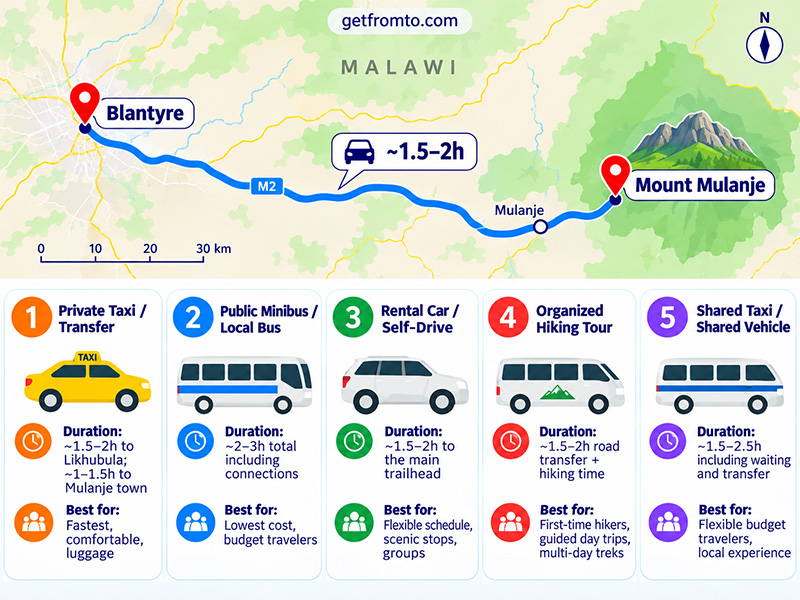
Mount Mulanje, one of Malawi’s most spectacular hiking destinations, lies southeast of Blantyre. Travelers can reach the mountain by private taxi, rental car, local minibus, or organized tour. The journey typically takes 1–2.5 hours depending on your destination and transportation. This guide explains the best routes, estimated costs, booking options, and how to reach the main hiking trailheads.
At A Glance (Blantyre to Mount Mulanje (Malawi))
| Mode | Duration | Best For |
|---|---|---|
| 🚕 Private Taxi / Transfer (Direct to Trailhead) | ~1.5–2h to Likhubula; ~1–1.5h to Mulanje town | Fastest, comfortable, luggage |
| 🏷️ Cost: Budget ~MWK 80,000–180,000+ per vehicle one-way to the mountain area; confirm actual quotes » request transfer quote | ||
| 🚌 Public Minibus / Local Bus + Trailhead Transfer | ~2–3h total including connections | Lowest cost, budget travelers |
| 🏷️ Cost: Allow ~MWK 3,000–10,000 pp for the main-road leg, plus a locally negotiated final transfer; fares are not fixed | ||
| 🚗 Rental Car / Self-Drive | ~1.5–2h to the main trailhead | Flexible schedule, scenic stops, groups |
| 🏷️ Cost: Allow ~MWK 80,000–200,000+ per rental day, depending on vehicle and supplier, plus fuel » compare car rentals | ||
| 🥾 Organized Hiking Tour + Transport | ~1.5–2h road transfer + hiking time | First-time hikers, guided day trips, multi-day treks |
| 🏷️ Cost: Request a package quote; as a planning allowance, private guided day trips with Blantyre transfers may cost US$80–200+ pp, depending on group size and inclusions » local trekking operator | ||
| 🚐 Shared Taxi / Informal Shared Vehicle + Local Transfer | ~1.5–2.5h including waiting and transfer | Flexible budget travelers, local experience |
| 🏷️ Cost: Allow ~MWK 5,000–15,000+ pp for an available shared ride toward Mulanje, plus onward transport; negotiate locally | ||
Which Option or Route Should You Choose?
- Fastest and most convenient: Choose a private taxi or door-to-door transfer from Blantyre to the Likhubula Forestry Office. This minimizes connections and is especially useful when carrying hiking equipment.
- Cheapest and most economical: Take a public minibus or local bus from Blantyre or Limbe toward Mulanje, then arrange a short onward ride to the mountain’s main trailhead.
- Best for independent exploration: A rental car gives you control over departure times and allows stops near the Thyolo tea estates or other viewpoints along the scenic southern route.
- Best for first-time mountain visitors: An organized hiking tour can combine transportation, a local mountain guide, hiking arrangements, and overnight accommodation where needed.
- Best for flexible travelers on a budget: An informal shared taxi may offer a quicker alternative to a stopping minibus, although vehicle availability and fares are unpredictable.
- Best for scenic driving: Travel via Thyolo and its tea-growing countryside when road conditions and your schedule allow. The newer M7 corridor provides a more direct alternative toward Mulanje.
How to Book and Practical Tips
- Choose your exact mountain destination: Mulanje town and Mount Mulanje are not the same stop. The popular Likhubula Forestry Office trailhead is approximately 10 km from the Chitakale area and requires an additional road transfer.
- Arrange guides before hiking: Contact InfoMulanje, the official mountain information and booking center, for registered guides, porters, mountain huts, and current hiking requirements.
- Confirm transport fares in advance: Local transport and private-transfer prices can change significantly. Ask whether the quoted price includes the final approach to Likhubula, waiting time, and your return journey.
- Leave Blantyre early: Depart around 6–7 AM for a day hike so you have adequate daylight for the road journey, registration, walking, and return. Longer mountain ascents require separate planning.
- Carry cash and hiking supplies: Bring Malawian kwacha for transport and local charges, along with drinking water, food, rain protection, and suitable footwear. Confirm accepted payment methods with the forestry office.
- Check weather and trail conditions: The generally drier months from May to October are popular for hiking. Mountain weather can change quickly, and conditions on higher trails can differ significantly from those in Blantyre.
- Book accommodation when necessary: Multi-day hikers should reserve mountain huts in advance. For a hotel stay before departure, compare Blantyre hotels and guesthouses or arrange accommodation near the mountain.
- Plan the return trip: Public transport becomes less predictable later in the day. Arrange a return driver or overnight stay rather than relying on finding transport after a long hike.
🚕 Option 1 — Private Taxi / Transfer (Fastest and Most Convenient)
Direct transfer Trailhead drop-off Best for luggage
- Overview: A private taxi is the easiest way to reach Mount Mulanje from Blantyre. The main road journey to the Mulanje/Chitakale area is roughly 65–75 km, depending on the route. Continue along the local access road to Likhubula Forestry Office, a popular starting point for mountain hikes. Allow approximately 1.5–2 hours from central Blantyre to Likhubula in normal conditions. The direct M7 route is generally quicker, while the route via Thyolo offers more tea-estate scenery.
- How to book (with price): Arrange a vehicle through your Blantyre hotel, contact a local taxi operator, or request a quotation through GetTransfer if a suitable provider is available. For planning, allow approximately MWK 80,000–180,000 or more per vehicle one-way to the mountain area; this is a broad budget estimate rather than a verified tariff. Request a separate quotation for a round trip with driver waiting time. Conventional local taxis or hotel-arranged drivers are more dependable choices than relying on app-based ride-hailing coverage for this rural destination.
- Pros: Direct hotel pickup, flexible departure time, easier luggage handling, and the possibility of arriving at the trailhead without changing vehicles. Cons: Higher cost than local transport, varying driver quotations, and potentially expensive waiting charges for long hikes.
Step-by-step: Private Taxi / Transfer
- Choose your pickup location: Arrange collection from central Blantyre, your hotel, Limbe, or Chileka International Airport if you are arriving by air.
- Book a vehicle: Ask your accommodation for a trusted driver or request a private-transfer quotation. Confirm that the driver knows Likhubula Forestry Office rather than only Mulanje town.
- Agree on the total fare: Clarify whether the price includes fuel, mountain approach roads, parking, waiting time, and a return transfer.
- Leave Blantyre: Travel toward Limbe and follow the main road connection toward Mulanje. Your driver can use the more direct M7 route or the longer route through Thyolo, depending on conditions.
- Continue to Chitakale: Reach the Mulanje area and follow directions toward the Chitakale junction, where InfoMulanje provides local hiking information.
- Take the Likhubula access road: Turn toward the mountain and continue approximately 10 km along the local road to the forestry office area.
- Arrive at Likhubula Forestry Office: Meet your guide, confirm access requirements, and complete any necessary registration or payments before beginning your hike.
- Confirm your return pickup: If returning to Blantyre the same day, agree on the collection time and exact meeting location before the driver leaves.
Getting to the main departure points (Blantyre City, Limbe and Chileka Airport)
- Central Blantyre: Hotels and guesthouses can usually help arrange private transport directly from their entrances.
- Limbe: Located southeast of central Blantyre, Limbe is a convenient pickup location for travelers continuing toward Mulanje.
- Chileka International Airport: Arrange airport pickup in advance and confirm the additional travel time from the airport to the mountain.
- Likhubula Forestry Office: Specify this as the destination if you intend to start hiking immediately rather than stop in Mulanje town.
- Locations/Trip Planner: 🔗 Google Map / 🔗 OpenStreetMap (to Mulanje town; continue to Likhubula)
🚌 Option 2 — Public Minibus / Local Bus + Trailhead Transfer (Cheapest Option)
Low cost Local transport Connection required
- Overview: Local minibuses and buses operate between the Blantyre/Limbe area and Mulanje. These are the most affordable options for reaching the mountain region. The main journey generally takes 1.5–2 hours depending on stops, passenger loading, and road conditions. From Mulanje town or Chitakale, arrange a motorcycle taxi, local vehicle, or private taxi to Likhubula Forestry Office. The total trip may take 2–3 hours or longer if connections are slow.
- How to book (with price): Usually, no online booking is necessary for local minibuses. Ask for a Mulanje-bound vehicle at an established Blantyre or Limbe minibus departure area and confirm the destination with the conductor. Allow around MWK 3,000–10,000 per person as a planning range for the main journey, not a confirmed official fare. The final road transfer to Likhubula is charged separately and must be negotiated locally. Confirm current services with your accommodation or Mount Mulanje Conservation Trust’s transport information.
- Pros: Lowest-cost scheduled or regularly operating local transport, suitable for backpackers, and an opportunity to experience everyday travel in Malawi. Cons: Crowding, unpredictable departure times, limited space for equipment, and the need for a separate transfer to the mountain trailhead.
Step-by-step: Public Minibus / Local Bus
- Reach the local minibus departure area: Ask your hotel for the current boarding point in Blantyre or Limbe for vehicles heading to Mulanje. Departure points can change, so confirm locally rather than assuming a fixed terminal.
- Find a Mulanje-bound vehicle: Look for a local minibus or bus operating toward Mulanje town, and ask whether it stops at Chitakale.
- Confirm your fare and destination: Tell the conductor you are heading to Mount Mulanje and want to continue to Likhubula Forestry Office.
- Board and pay: Carry small Malawian kwacha notes. Keep valuable items secure and avoid carrying oversized hiking bags on crowded vehicles if possible.
- Travel toward Mulanje: Follow the road southeast from the Blantyre/Limbe area. Expect intermediate stops and potentially a wait for the vehicle to fill.
- Get off at Chitakale or Mulanje: Ask the conductor which stop provides the easiest access to InfoMulanje and the Likhubula road.
- Arrange onward transportation: Negotiate with a local taxi or motorcycle taxi for the approximately 10 km journey toward Likhubula Forestry Office. A motorcycle may be unsuitable for travelers with large packs.
- Register before hiking: Once at the trailhead, check local access rules, meet your guide, and begin your planned hike. If returning the same day, arrange the final transfer back to Chitakale in advance.
Getting to the main embarking points (Blantyre and Limbe Minibus Areas)
- Blantyre city center: Ask your accommodation or a trusted local contact for the current Mulanje-bound minibus boarding location.
- Limbe transport area: Limbe is another useful departure point for eastbound local transport. Confirm that your vehicle continues toward Mulanje rather than terminating in an intermediate town.
- Chitakale Trading Centre: This is a practical transfer point near the road toward Likhubula. InfoMulanje is located in the Chitakale area.
- Likhubula Forestry Office: The final approximately 10 km from Chitakale is not normally included in the Blantyre–Mulanje minibus fare.
- Locations/Trip Planner: 🔗 Google Map / 🔗 OpenStreetMap (road reference to Mulanje; not a live bus itinerary)
🚗 Option 3 — Rental Car / Self-Drive (Most Flexible and Scenic)
Flexible schedule Scenic stops Road-dependent
- Overview: Driving from Blantyre to Mount Mulanje allows you to choose between the more direct M7 corridor and the traditional route through Thyolo’s scenic tea-growing countryside. The main road to Mulanje town takes approximately 1–1.5 hours, with additional time to Likhubula Forestry Office or another trailhead. Allow approximately 1.5–2 hours to reach the main hiking area, longer with sightseeing stops or poor road conditions.
- How to book (with price): Compare rental car availability for Malawi or contact reputable car hire agencies in Blantyre. As a broad budget allowance, rental vehicles may cost MWK 80,000–200,000+ per day, with prices depending on vehicle category, insurance, availability, and rental conditions. Fuel, additional drivers, and deposit requirements may cost extra. Check whether your chosen vehicle is suitable for unpaved mountain access roads.
- Pros: Full control over departure and return times, flexibility to visit tea estates, comfortable luggage storage, and good value when sharing costs among several travelers. Cons: Driving responsibilities, fuel and parking costs, possible poor road surfaces near trailheads, and limited value if the vehicle remains parked during a multi-day trek.
Step-by-step: Rental Car / Self-Drive
- Reserve a suitable vehicle: Book a rental in Blantyre or arrange collection at Chileka International Airport. Consider a high-clearance vehicle if visiting more remote access points.
- Check the rental conditions: Confirm insurance, permitted driving areas, roadside assistance, mileage restrictions, and the requirements for using your driving license in Malawi.
- Prepare navigation: Download offline maps covering Blantyre, Limbe, Thyolo, Mulanje, Chitakale, and Likhubula. Mobile coverage may become inconsistent in remote areas.
- Depart Blantyre: Drive toward Limbe and continue southeast toward Mulanje.
- Select your route: Use the newer M7 for a relatively direct journey, or the route via Thyolo for views of tea plantations and the southern countryside. Check current road conditions before choosing.
- Reach Chitakale: Follow the signs or your offline map toward the Likhubula access road. Stop at InfoMulanje if you need information about guides, trails, or accommodation.
- Continue to the forestry office: Drive along the mountain approach road, reducing speed on rough or unpaved sections and checking that your rental agreement permits access.
- Park and begin your visit: Use an appropriate parking area, confirm any vehicle or conservation charges, and register before hiking.
- Return to Blantyre: Leave enough daylight for the return drive, particularly if your route includes rural roads with limited lighting.
Getting to the main rental and departure points (Blantyre and Chileka Airport)
- Blantyre city center: Many rental arrangements can begin at a city office or through delivery to your accommodation, depending on the supplier.
- Chileka International Airport: A useful collection point for travelers arriving by air, provided you have arranged a rental and confirmed collection details.
- Limbe: Located on the southeastern side of Blantyre, Limbe provides convenient access to roads heading toward Mulanje.
- Thyolo: A scenic waypoint for travelers who prefer the tea-estate route rather than the most direct road.
- Likhubula Forestry Office: The main destination for hikers using the Likhubula approach. Confirm parking availability and whether your vehicle can negotiate the access road.
- Locations/Trip Planner: 🔗 Google Map / 🔗 OpenStreetMap (to Mulanje town; extend to the chosen trailhead)
🥾 Option 4 — Organized Hiking Tour + Transport (Best for First-Time Hikers)
Guided hiking Transport arranged Advance booking
- Overview: An organized Mount Mulanje tour is one of the easiest ways to combine road transportation with a properly planned hike. Depending on the operator and package, your trip may include Blantyre hotel pickup, transport to Likhubula or another trailhead, a local guide, porter services, meals, and mountain hut arrangements. The transfer usually takes approximately 1.5–2 hours, while hiking can range from a few hours for lower-slope walks to several days for higher mountain routes.
- How to book (with price): Contact Trek Mulanje, a locally operated hiking company listed by Malawi Tourism, or arrange guides and mountain accommodation through InfoMulanje. A private day-tour package with transport may require a budget of approximately US$80–200+ per person, but no standard package price applies. Multi-day expeditions cost more and must be quoted individually. Check whether the package includes park charges, hut accommodation, guides, porters, food, and return transport.
- Pros: Simplified planning, local route knowledge, organized transportation, assistance with mountain accommodation, and a more suitable approach for visitors unfamiliar with Mulanje’s terrain. Cons: Higher overall cost, advance coordination required, and less freedom to change the hiking schedule.
Step-by-step: Organized Hiking Tour + Transport
- Choose a hiking itinerary: Decide whether you want a short walk near the foothills, a full-day ascent, or a multi-day trek toward the mountain plateau and Sapitwa Peak.
- Contact a trekking provider: Ask a locally established operator about available dates, hiking difficulty, guide arrangements, and pickup from Blantyre.
- Review the package: Confirm which services are included and whether trailhead transport, guide fees, porter costs, meals, and mountain huts are covered.
- Prepare equipment: Bring sturdy footwear, rain protection, warm layers, drinking water, food, and any additional equipment recommended by the guide.
- Meet your driver in Blantyre: Most private tours can coordinate a hotel pickup or another agreed meeting point, subject to the operator’s arrangements.
- Travel toward Mount Mulanje: The driver follows the main road toward Mulanje and continues to the selected hiking starting point.
- Complete mountain formalities: Check in at the relevant forestry office or designated registration point and confirm the route, weather, fees, and planned return time with your guide.
- Begin the guided hike: Follow the selected itinerary. Short visits may focus on lower forest trails and waterfalls, while multi-day climbs can involve steep ascents and overnight mountain huts.
- Return or stay overnight: Day-trip participants return to the agreed meeting point for transport back to Blantyre. Multi-day hikers follow their prearranged hut and descent schedule.
Getting to the main embarking points (Blantyre Hotels and Mulanje Trailheads)
- Central Blantyre hotels: Request a door-to-door pickup where available. Confirm the collection time the day before your tour.
- Chileka International Airport: Some operators can arrange airport collection for travelers continuing directly toward Mulanje; advance notice and additional charges may apply.
- InfoMulanje at Chitakale: An information and reservation center for mountain activities, guides, porters, and accommodation.
- Likhubula Forestry Office: A common starting point for hikes toward Chambe and other parts of the mountain.
- Other access points: Certain hiking routes begin from different sides of the massif. Confirm the actual trailhead rather than assuming every trek starts at Likhubula.
- Locations/Trip Planner: 🔗 Google Map / 🔗 OpenStreetMap (road reference to Mulanje; confirm your actual trailhead)
🚐 Option 5 — Shared Taxi / Informal Shared Vehicle (Flexible Budget Alternative)
Shared cost Local transport Availability varies
- Overview: In addition to regular minibuses, travelers may find locally arranged shared taxis or vehicles carrying passengers between the Blantyre/Limbe area and Mulanje. These are informal arrangements rather than a guaranteed scheduled service. Vehicles typically use the main road toward Mulanje, with passengers arranging onward transport to the mountain trailhead. Allow approximately 1.5–2.5 hours for the main journey and onward connection, potentially longer if waiting for other passengers.
- How to book (with price): Ask your accommodation, an established local transport contact, or staff at a recognized transport departure area about shared vehicles heading to Mulanje. As an indicative planning allowance, a seat might cost MWK 5,000–15,000 or more depending on the driver, route, and number of passengers. This is not a published tariff. Confirm that you are paying for one seat rather than hiring the entire car. A separate transfer to Likhubula may be required.
- Pros: Potentially faster than stopping minibuses, lower per-person cost than hiring an entire private taxi, and flexible arrangements when suitable vehicles are available. Cons: No reliable timetable, inconsistent comfort, uncertain availability, and the risk of unclear fares or overcrowded vehicles.
Step-by-step: Shared Taxi / Informal Shared Vehicle
- Ask about shared transport: Check with your hotel or a trusted local contact in Blantyre or Limbe for vehicles traveling toward Mulanje.
- Confirm the destination: Ask whether the vehicle goes to Chitakale, Mulanje town, or another stop along the main road.
- Check the fare: Agree on the price per passenger, luggage charges, and payment arrangements before boarding.
- Wait for departure: Some shared vehicles depart once enough passengers have joined. Allow extra time if you have an appointment with a mountain guide.
- Travel toward Mulanje: Follow the main road from Blantyre or Limbe. Only use a vehicle that appears roadworthy and has a proper seat for each passenger.
- Exit at your agreed stop: Request a drop-off at Chitakale or a convenient location for reaching Likhubula.
- Arrange onward transport: Hire a local vehicle for the final journey to the forestry office. Confirm the fare and access-road conditions before departing.
- Prepare your return: Ask about available afternoon shared transport, but arrange a backup taxi or overnight accommodation if hiking late.
Getting to the main embarking points (Blantyre, Limbe and Chitakale)
- Blantyre city center: Ask hotel staff for current shared-vehicle pickup locations rather than searching for an unverified fixed terminal.
- Limbe transport area: Another practical place to inquire about vehicles heading toward the Mulanje district.
- Chitakale Trading Centre: A useful arrival and transfer point for continuing toward the mountain.
- Mulanje town: Travelers arriving farther south or east can arrange onward transport back toward the appropriate mountain access road.
- Likhubula Forestry Office: Shared intertown vehicles generally should not be assumed to provide direct access to the trailhead.
- Locations/Trip Planner: 🔗 Google Map / 🔗 OpenStreetMap (to Mulanje town; continue by local transfer)
FAQ (Blantyre to Mount Mulanje (Malawi))
How far is Mount Mulanje from Blantyre?
The road distance from Blantyre to Mulanje town is approximately 65–75 km, depending on the route. The main Likhubula hiking access point is farther away, requiring an additional drive from the Chitakale area. Allow roughly 1.5–2 hours by private vehicle to reach Likhubula, depending on road conditions and your starting point.
What is the cheapest way to get from Blantyre to Mount Mulanje?
The cheapest practical option is usually a public minibus or local bus from Blantyre or Limbe to Mulanje or Chitakale, followed by a local transfer to Likhubula Forestry Office. As a broad planning allowance, budget MWK 3,000–10,000 per person for the main-road journey, plus onward transportation. Confirm the current fare locally before boarding.
Can you visit Mount Mulanje on a day trip from Blantyre?
Yes. A day trip is practical if you leave Blantyre early and choose a shorter hike near the lower mountain slopes, forest trails, or waterfalls. Longer ascents toward the plateau or Sapitwa Peak usually require substantially more time, often involving overnight stays. Arrange a suitable local guide and confirm your route before departure.
Where is the main entrance or hiking starting point for Mount Mulanje?
Likhubula Forestry Office is one of the most commonly used starting points for Mount Mulanje hikes. It is approximately 10 km from the Chitakale area near Mulanje. Other trails begin on different sides of the massif, so your hiking starting point depends on the route you choose. InfoMulanje can help arrange guides and identify the correct trailhead.
Do you need a guide to hike Mount Mulanje?
Hiring a knowledgeable local guide is strongly recommended, particularly for first-time visitors, higher routes, and multi-day treks. The mountain has steep terrain, rapidly changing weather, and areas where navigation can become difficult. Check current registration and guide requirements with InfoMulanje or the relevant forestry office. Multi-day visitors should also arrange mountain hut accommodation in advance.
What is the best time to visit Mount Mulanje?
The generally drier period from May to October is popular for trekking because trails are often less muddy and visibility can be better. However, mountain temperatures can be cold, especially at higher elevations, and mist, rain, or strong winds can occur at any time. Check forecasts and local trail conditions immediately before starting your hike.

Related Tours/Services
Popular Routes
Recent Routes
- How to get from Kpalimé to Mount Agou (Togo)
- How to get from Blantyre to Mount Mulanje (Malawi)
- How to get from Cape Coast to Elmina Castle
- How to get from Lagos to Abeokuta (Nigeria)
- How to get from Khorog to Murghab
- How to get from Cozumel Puerta Maya Cruise Terminal to Chankanaab Beach Adventure Park
- How to get from Nassau Cruise Port to Atlantis Paradise Island
- How to get from Whittier Cruise Terminal to Anchorage
- How to get from Kotor Cruise Port to Budva
- How to get from Dubrovnik Gruz Cruise Port to Dubrovnik Old Town
Top Travel Gears

travel inspira Luggage Scale Digital Suitcase Weight Scale for Travel | Blue Backlight, Rubber Paint Handle, Tare & Data Lock, Auto-Off, Battery Included, 110 Pounds, Travel Essentials

LISEN Airplane Travel Essentials for Flying Airplane Phone Holder for Desk Phone Stand Hands Free MagSafe Travel Accessories Long Flight Travel Tech Halloween Decorations Gifts for Men

zelin Anti Theft Zipper Clips, Travel Essentials, Carabiner, 4Pcs Grey | Elegant Zinc Alloy Zipper Pull Locks, Airplane Gadgets and Travel Accessories for Backpacks, Commuting and Outdoor Safety
2026 Travel Essentials for Apple Watch Charger,Cruise Vacation Camping Essentials,iPhone Charger,Multi Charging Cable,3 in 2 Charging Docks for iWatch Series 12 11-2/Ultra,iPhone 18 17-12,Car

FYY Electronic Organizer, Travel Tech Pouch Bag, Cable Organizer Black | Wrist Strap, Waterproof, Double Layers Portable Electronics Travel Carrying Case for Cord, Charger, Daily Business Trips Use
