

How to get from Lagos to Abeokuta (Nigeria)

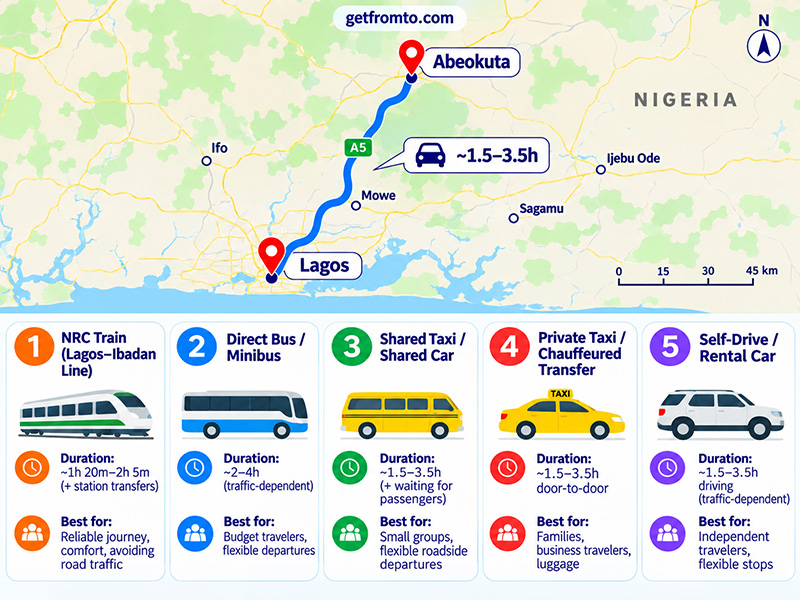
Traveling from Lagos to Abeokuta, the capital of Ogun State in Nigeria, is straightforward by train, bus, shared taxi, or private car. The journey covers approximately 80–110 km, depending on your starting point and route. The Lagos–Ibadan railway offers a convenient alternative to road traffic, while buses and private transfers provide flexible departure times.
At A Glance (Lagos to Abeokuta (Nigeria))
| Mode | Duration | Best For |
|---|---|---|
| 🚆 NRC Train (Lagos–Ibadan Line) | ~1h 20m–2h 5m on train (+ station transfers) | Reliable journey, comfort, avoiding road traffic |
| 🏷️ Cost: ₦3,000 regular / ₦4,500 business / ₦9,000 first class, adult one-way » book train tickets | official timetable | ||
| 🚌 Direct Bus / Minibus | ~2–4h (traffic-dependent) | Budget travelers, flexible departures |
| 🏷️ Cost: Allow approximately ₦3,000–7,000 per person as a planning budget; no verified fixed route fare is published, so confirm at the motor park | ||
| 🚕 Shared Taxi / Shared Car | ~1.5–3.5h (+ waiting for passengers) | Small groups, flexible roadside departures |
| 🏷️ Cost: Allow approximately ₦4,000–8,000 per seat as an indicative budget; confirm the actual fare before boarding | ||
| 🚘 Private Taxi / Chauffeured Transfer | ~1.5–3.5h door-to-door, longer in congestion | Families, business travelers, luggage |
| 🏷️ Cost: Budget roughly ₦40,000–100,000+ per vehicle as a preliminary allowance; obtain a current quote » request a transfer | ||
| 🚗 Self-Drive / Rental Car | ~1.5–3.5h driving, traffic-dependent | Independent travelers, flexible stops |
| 🏷️ Cost: Fuel, parking and any tolls; rental cars often require a separate daily quote » compare rental cars | ||
Which Option or Route Should You Choose?
- Most reliable and comfortable: Choose the NRC Lagos–Abeokuta train if its timetable suits your plans. The train avoids Lagos–Abeokuta Expressway congestion and offers published fares, air-conditioned seating, and a predictable railway journey.
- Cheapest and most flexible: A direct bus or minibus is practical for travelers who prefer road transport and do not want to follow a fixed train schedule. Compare the current fare with the ₦3,000 regular train ticket before deciding.
- Good option for solo travelers: A shared taxi may offer a convenient departure from a Lagos transport park, although you may need to wait until enough passengers have boarded.
- Fastest door-to-door when traffic is light: A private taxi or chauffeured transfer eliminates station transfers and takes you directly to your Abeokuta hotel, business meeting, or tourist attraction.
- Most flexible for sightseeing: A rental car or self-drive journey is suitable if you plan to visit Olumo Rock, the Adire markets, and other locations around Abeokuta without arranging separate taxis.
How to Book and Practical Tips
- Check train departures: The Nigerian Railway Corporation timetable lists two Lagos departures on Sundays through Thursdays and three on Fridays and Saturdays. Confirm the latest schedule before traveling because services can change.
- Use official railway booking: Book Lagos–Abeokuta train tickets through NRC’s authorized Lagos–Ibadan ticketing portal. Avoid unofficial websites and payments to personal bank accounts.
- Choose the right Lagos departure point: Mobolaji Johnson Station in Ebute Metta serves the intercity railway. Road travelers commonly inquire about Abeokuta-bound vehicles around Oshodi, Iyana Ipaja, Agege, and other major transport areas, but specific services must be verified locally.
- Allow extra road travel time: Lagos traffic can be severe around Oshodi, Agege, Abule Egba, and Sango-Ota. Roadworks and congestion on the Lagos–Abeokuta Expressway can substantially extend journeys.
- Confirm the final destination: Abeokuta includes areas such as Kuto, Panseke, Sapon, and Ake. Ask where your bus or shared taxi terminates and budget for a final local transfer if necessary.
- Consider ride-hailing: Uber, Bolt, and inDrive operate in parts of Lagos. You may be able to request an intercity journey, but acceptance, pricing, and Abeokuta coverage vary. Confirm the complete trip directly with the driver.
- Carry cash and valid identification: Nigerian naira is useful for local buses, shared taxis, and smaller transport providers. Train passengers should carry the identification required for their ticket.
- Plan your Abeokuta visit: Travelers staying overnight can compare Abeokuta hotels and accommodation. For sightseeing, Olumo Rock, historic Ake, and the city’s Adire textile markets are popular places to explore.
🚆 Option 1 — NRC Train (Most Reliable and Comfortable)
Good value Avoids road traffic Fixed departures
- Overview: The Nigerian Railway Corporation (NRC) operates the Lagos–Ibadan Train Service, which stops at Abeokuta. Trains depart from Mobolaji Johnson Station in Ebute Metta, Lagos, and stop at Professor Wole Soyinka Station in Abeokuta. The scheduled Lagos–Abeokuta segment takes approximately 1 hour 22 minutes to 2 hours 1 minute, depending on the train. This is one of the most predictable ways to travel between the cities because the train avoids highway congestion.
- How to book (with price): Buy tickets through the official Lagos–Ibadan train booking portal, accessible through the NRC booking page. Published Lagos–Abeokuta adult one-way fares are ₦3,000 regular class, ₦4,500 business class, and ₦9,000 first class. The published regular-class fare for minors is ₦2,000. Verify prices and available seats before purchase.
- Typical departure schedule: Sundays–Thursdays: Lagos departures at approximately 8:00 AM and 4:00 PM, reaching Abeokuta around 9:31 AM and 5:31 PM. Fridays–Saturdays: departures at approximately 7:15 AM, 1:40 PM, and 4:00 PM, reaching Abeokuta around 9:16 AM, 3:02 PM, and 5:31 PM. Times are based on the published NRC timetable and are subject to change.
- Pros: Published ticket prices, comfortable seating, minimal exposure to road traffic, and suitability for business travelers and families. Cons: Limited departure times, advance planning required, and additional transport needed between the railway stations and city-center destinations.
Step-by-step: NRC Train from Lagos to Abeokuta
- Choose your train: Visit the NRC ticketing portal and select Lagos as your departure station and Abeokuta as your destination. Choose the travel date, departure, and seating class.
- Purchase your ticket: Enter the required passenger information, complete payment using an approved method, and save your booking confirmation or electronic ticket.
- Travel to Mobolaji Johnson Station: Head to the railway terminal along Murtala Muhammed Way in the Ebute Metta/Alagomeji area of Lagos. Allow extra time for city traffic.
- Arrive before departure: Aim to reach the station approximately 45–60 minutes early to allow time for security checks, ticket verification, and boarding instructions.
- Board the Lagos–Ibadan train: Follow station announcements and confirm your carriage and seat. Keep your ticket or booking confirmation available.
- Travel toward Abeokuta: The railway passes through suburban Lagos and parts of Ogun State. Intermediate station calls vary by service.
- Disembark at Professor Wole Soyinka Station: Leave the train at Abeokuta rather than continuing toward Ibadan.
- Continue to central Abeokuta: Arrange a taxi or a locally available vehicle from the station to Kuto, Ake, Olumo Rock, or your accommodation. The station is outside the central sightseeing areas, so allow additional transfer time and cost.
Getting to the main embarking points (Mobolaji Johnson Station, Ebute Metta)
- From Lagos Island: Take a taxi or a ride-hailing vehicle toward Ebute Metta via the appropriate mainland bridge. Allow generous travel time during morning congestion.
- From Victoria Island or Lekki: Use a taxi, Uber, Bolt, or inDrive toward Mobolaji Johnson Station. Travel time varies considerably depending on bridge and expressway traffic.
- From Ikeja: Take a taxi toward Yaba and Ebute Metta. If you are closer to Agege, ask NRC whether the selected train accepts boarding at Babatunde Raji Fashola Station, Agege, and book the correct departure station if available.
- From Murtala Muhammed International Airport: Arrange a taxi or airport transfer toward Ebute Metta. Allow extra time for airport traffic and railway check-in.
- From Abeokuta railway station: Continue by locally arranged taxi or another available road vehicle to your final destination. Confirm the fare before leaving the station.
- Locations/Trip Planner: 🔗 Google Map / 🔗 OpenStreetMap
🚌 Option 2 — Direct Bus / Minibus (Budget-Friendly and Flexible)
Budget option Flexible departures Traffic-dependent
- Overview: Shared buses and minibuses operate along the Lagos–Abeokuta road corridor, generally following the Lagos–Abeokuta Expressway through areas such as Agege, Abule Egba, Sango-Ota, and Ifo before reaching Abeokuta. Depending on the boarding point and traffic, the road journey typically takes approximately 2–4 hours, sometimes longer. Travelers can inquire about departures from major transport areas including Oshodi, Iyana Ipaja, Agege, and Ojota, but specific Abeokuta services and boarding points vary.
- How to book (with price): Most local minibus journeys are arranged directly at a motor park rather than through a centralized online booking system. As an indicative planning allowance, budget approximately ₦3,000–7,000 per person, but this is not a verified current tariff. Ask the operator for the full fare, departure point, and destination before paying. Buses may wait for enough passengers before departing.
- Pros: Usually affordable, multiple potential boarding locations, no need to follow a limited railway timetable, and access to road-based drop-off points. Cons: Variable fares, traffic delays, possible crowding, uncertain departure times, and additional local transport if the bus does not terminate near your destination.
Step-by-step: Direct Bus / Minibus
- Identify an Abeokuta-bound transport park: Ask your hotel, a trusted local contact, or a motor park information desk about current departures. Oshodi is a known Lagos–Abeokuta transport connection, but availability should be checked before traveling.
- Reach the correct boarding area: Travel by taxi, local bus, or ride-hailing vehicle to the confirmed motor park. Avoid heading to a park based solely on an old route listing.
- Find a vehicle going directly to Abeokuta: Confirm that the bus continues beyond Sango-Ota or Ifo and reaches Abeokuta rather than terminating partway along the expressway.
- Confirm the final stop: Ask whether the service terminates at Kuto or another location in Abeokuta. Tell the operator where you intend to go.
- Agree on the fare: Confirm the full fare, any luggage charges, and whether payment is made at a staffed ticket counter or directly to the authorized conductor.
- Board and depart: Keep your belongings secure and allow additional time if the driver is waiting for passengers.
- Travel along the Lagos–Abeokuta Expressway: The journey generally passes through the Sango-Ota and Ifo corridor before continuing toward Abeokuta.
- Arrive in Abeokuta: Get off at the confirmed terminal or drop-off point and take a local taxi, keke, or other suitable vehicle to your hotel or sightseeing destination.
Getting to the main embarking points (Oshodi and Other Lagos Motor Parks)
- Oshodi: A major transport hub accessible from many parts of Lagos. Ask the park operators where Abeokuta-bound vehicles currently depart.
- Iyana Ipaja: A practical area for travelers staying toward western Lagos. Check whether a direct Abeokuta service is operating before making the journey.
- Agege and Abule Egba: These areas lie near the Lagos–Abeokuta Expressway. Ask locally about available intercity vehicles and approved pickup points.
- Ojota: A major interstate transport area in Lagos. Confirm an Abeokuta-specific departure rather than assuming every intercity operator serves the route.
- From Victoria Island, Lekki, or Lagos Island: Arrange a taxi or ride-hailing trip to the confirmed motor park and allow extra time for cross-city traffic.
- Abeokuta arrival: Kuto is a commonly reported road transport destination, but terminals vary by operator. Confirm whether the vehicle stops near Kuto, Sapon, Panseke, or another location.
- Locations/Trip Planner: 🔗 Google Map / 🔗 OpenStreetMap
🚕 Option 3 — Shared Taxi / Shared Car (Flexible Road Travel)
Shared cost Flexible departure Seat-dependent
- Overview: Shared taxis and passenger cars are another way to travel between Lagos and Abeokuta. Drivers usually collect passengers from transport parks or recognized roadside loading points and follow the Lagos–Abeokuta road corridor. The driving portion may take approximately 1.5–3.5 hours, depending on the starting point and traffic. Waiting for seats to fill can add time.
- How to book (with price): Ask at a recognized transport park or through a trusted local driver for a shared vehicle going directly to Abeokuta. A rough planning allowance is ₦4,000–8,000 per seat, but no dependable published route tariff is available. Confirm the number of passengers, luggage policy, full fare, and exact arrival point before paying. If traveling as a group, compare the combined seat cost with a private transfer quotation.
- Pros: May depart more flexibly than scheduled transport, fewer passengers than some minibuses, and convenient for travelers near major road corridors. Cons: Waiting for passengers, inconsistent fares, limited luggage space, and road congestion.
Step-by-step: Shared Taxi / Shared Car
- Choose a departure area: Ask about Abeokuta-bound shared cars at a recognized Lagos motor park, particularly around transport hubs connected to the Lagos–Abeokuta Expressway.
- Check the vehicle’s destination: Confirm that the car goes all the way to Abeokuta rather than stopping at Sango-Ota or Ifo.
- Confirm passenger arrangements: Ask how many passengers will travel, whether the vehicle waits until full, and whether your luggage fits comfortably.
- Agree on the fare: Verify the per-seat price and whether an extra seat is required for oversized luggage.
- Board the shared vehicle: Keep important documents, money, and electronics with you. Avoid overcrowded vehicles or drivers who cannot explain the route and fare.
- Travel toward Ogun State: The typical journey follows the expressway through Sango-Ota and Ifo, continuing toward Abeokuta.
- Arrive at the agreed stop: Confirm your drop-off in Abeokuta and arrange a short local journey to your accommodation or attraction if necessary.
Getting to the main embarking points (Lagos Shared-Car Loading Areas)
- Oshodi transport area: Ask at recognized loading points about Abeokuta-bound shared taxis and cars.
- Iyana Ipaja and Agege: These are potential places to inquire about shared road transport heading toward Ogun State. Vehicle availability is not guaranteed.
- Abule Egba and Sango-Ota corridor: Travelers already near the expressway may find onward shared transport without first traveling to central Lagos. Confirm an authorized and safe boarding location.
- From Lagos Island or Ikeja: Use local transportation or a ride-hailing service to reach a confirmed shared-car departure point.
- From Abeokuta drop-off points: Use a local taxi or keke to reach Kuto, Ake, Panseke, or your chosen hotel.
- Locations/Trip Planner: 🔗 Google Map / 🔗 OpenStreetMap
🚘 Option 4 — Private Taxi / Chauffeured Transfer (Most Convenient Door-to-Door)
Door-to-door Flexible schedule Higher cost
- Overview: A private taxi or pre-arranged chauffeur provides direct transportation from your Lagos accommodation, airport, or office to Abeokuta. The driver generally follows the Lagos–Abeokuta Expressway through Sango-Ota and Ifo. Allow approximately 1.5–3.5 hours for the journey, potentially longer when leaving Lagos Island, Lekki, or Victoria Island during heavy traffic.
- How to book (with price): Arrange a vehicle through your hotel, a reputable local transport company, or request a quotation through GetTransfer if available. For preliminary budgeting, allow roughly ₦40,000–100,000 or more per vehicle, but actual intercity quotes vary substantially by vehicle, pickup location, waiting time, and return arrangements. Uber, Bolt, and inDrive are possible alternatives for requesting a driver in Lagos, although an Abeokuta trip is subject to driver acceptance and platform coverage. Agree on any intercity surcharge before departure.
- Pros: Direct pickup and drop-off, comfortable for families and groups, useful with luggage, flexible departure times, and no need to change transport in Abeokuta. Cons: More expensive than shared services, vulnerable to road congestion, and possible additional charges for return travel or driver waiting.
Step-by-step: Private Taxi / Chauffeured Transfer
- Choose your pickup location: Arrange collection from your hotel in Lagos, Murtala Muhammed International Airport, Lagos Island, Victoria Island, Lekki, or another accessible location.
- Request a quotation: Contact a reputable transport company or compare available private transfers. Provide your exact Abeokuta destination and preferred departure time.
- Confirm the complete fare: Ask whether the price includes fuel, tolls, luggage, waiting, and the driver’s return journey. Clarify whether a round trip is available.
- Choose an appropriate departure time: Depart early if possible to reduce exposure to peak Lagos traffic, particularly around Oshodi, Agege, and the Sango-Ota corridor.
- Meet your driver: Verify the vehicle details and driver identity before boarding. Keep the destination pinned on your navigation app.
- Travel toward Abeokuta: Follow the most appropriate road route based on traffic conditions. Your driver may adjust the approach depending on the starting location.
- Arrive directly at your destination: Request drop-off at your hotel, Olumo Rock, the Ake area, Kuto, or another specified address in Abeokuta.
- Arrange the return if needed: For a same-day sightseeing trip, agree on a waiting allowance or scheduled collection time before the driver leaves.
Getting to the main pickup points (Lagos Hotels, Airport and City Areas)
- Murtala Muhammed International Airport: Pre-arranged transfers can collect passengers after arrival formalities. Confirm the terminal and pickup instructions with the driver.
- Ikeja: Hotels and residences around Ikeja are convenient starting points for a journey toward northern Lagos and the Ogun State corridor.
- Victoria Island and Lekki: Private transfers can collect you directly, but allow additional time to reach the mainland expressway.
- Lagos Island and Yaba: Arrange pickup at your accommodation or another easily identifiable location with safe roadside access.
- Abeokuta destination: Provide the specific hotel name, street address, or landmark. Avoid booking a transfer with only “Abeokuta” as the final destination if you require door-to-door service.
- Locations/Trip Planner: 🔗 Google Map / 🔗 OpenStreetMap
🚗 Option 5 — Self-Drive / Rental Car (Best for Flexibility and Sightseeing)
Flexible stops Independent travel Traffic-dependent
- Overview: Driving from Lagos to Abeokuta gives travelers the flexibility to choose their departure time, take breaks, and explore destinations around Ogun State. The common road route uses the Lagos–Abeokuta Expressway through Agege or Abule Egba, Sango-Ota, and Ifo before reaching Abeokuta. Allow approximately 1.5–3.5 hours under typical conditions, with substantially longer journeys possible during congestion or roadworks.
- How to book (with price): Travelers without their own vehicle can search for rental cars in Lagos or contact reputable local rental providers. Confirm whether self-drive rentals are available, as many Nigerian car-hire services are chauffeur-driven. Rental costs vary by vehicle, duration, insurance, and provider. Budget separately for fuel, parking, any tolls, and potential security deposits. Drivers must hold a valid license accepted in Nigeria and meet the rental company’s requirements.
- Pros: Total control over departure times, convenient for multiple stops, useful for visiting attractions outside central Abeokuta, and practical for small groups. Cons: Heavy Lagos traffic, unpredictable road conditions, navigation challenges, parking arrangements, and rental restrictions.
Step-by-step: Self-Drive / Rental Car
- Arrange your vehicle: Use your own car or reserve a suitable rental from a reputable provider in Lagos. Confirm that driving to Ogun State is allowed under the rental agreement.
- Check the vehicle: Inspect brakes, tires, spare tire, lights, fuel level, and required vehicle documents before departure.
- Plan your route: Set Abeokuta as the destination in Google Maps or another navigation app. Choose the route based on your Lagos starting point and current traffic.
- Head toward the Lagos–Abeokuta Expressway: Drivers starting from Ikeja, Agege, or northern Lagos can access the expressway through nearby connecting roads.
- Continue toward Sango-Ota: Follow the expressway out of Lagos toward Ogun State, watching for traffic restrictions, roadworks, and temporary diversions.
- Drive through the Ifo corridor: Continue toward Abeokuta while allowing extra time for busy junctions, commercial traffic, and uneven road sections.
- Enter Abeokuta: Follow signs or navigation directions toward the part of the city you wish to visit, such as Kuto, Ake, Panseke, or Olumo Rock.
- Park and explore: Use designated parking areas at your accommodation or attraction. For a day trip, plan your return before dark when practical.
Getting to the main departure points (Lagos Road Connections)
- From Ikeja: Follow the appropriate connecting roads toward Agege and the Lagos–Abeokuta Expressway.
- From Lagos Island: Cross to the mainland and follow navigation toward the northern road corridor. Allow significant time during peak traffic.
- From Victoria Island or Lekki: Reach the mainland through the appropriate bridge and road connections before continuing toward Abeokuta.
- From Murtala Muhammed International Airport: Rental car collection may be available from airport-area providers. Confirm pickup location and whether the vehicle is self-drive or chauffeur-driven.
- Abeokuta parking: Check parking arrangements before visiting busy markets, Olumo Rock, and central commercial areas.
- Locations/Trip Planner: 🔗 Google Map / 🔗 OpenStreetMap
FAQ (Lagos to Abeokuta (Nigeria))
How far is Abeokuta from Lagos?
Abeokuta is approximately 80–110 km from Lagos by road, depending on the starting point and route. The journey commonly takes 1.5–4 hours by road, although heavy congestion can extend travel time.
Is there a direct train from Lagos to Abeokuta?
Yes. The Nigerian Railway Corporation operates the Lagos–Ibadan Train Service, which stops at Professor Wole Soyinka Station in Abeokuta. Trains depart from Mobolaji Johnson Station in Ebute Metta, with additional intermediate boarding stations on certain services. Scheduled travel time from the Lagos terminal to Abeokuta is approximately 1 hour 22 minutes to 2 hours 1 minute.
How much is the Lagos to Abeokuta train ticket?
NRC’s published adult one-way fares are ₦3,000 for regular class, ₦4,500 for business class, and ₦9,000 for first class. The regular-class fare for minors is ₦2,000. Confirm current fares and availability through the official railway booking portal.
Where can I board a bus from Lagos to Abeokuta?
Travelers can inquire about Abeokuta-bound buses around major Lagos transport areas, including Oshodi, Iyana Ipaja, Agege, and Ojota. However, departure points and routes vary, and not all parks have verified direct services. Confirm the exact loading point, fare, and Abeokuta drop-off with the operator before traveling.
Which is better from Lagos to Abeokuta, train or bus?
The train is generally better for predictable journey times, comfortable seating, and avoiding expressway congestion. A bus may be more convenient if you cannot make the train departures or are starting close to an Abeokuta-bound road transport park. Compare total journey costs, including transport to and from the railway stations.
Can I visit Abeokuta from Lagos as a day trip?
Yes. Abeokuta is a reasonable day-trip destination from Lagos, particularly by train or early private-car departure. Popular attractions include Olumo Rock, the historic Ake area, and Adire textile markets. Check return train times carefully and arrange transport between Abeokuta’s railway station and the city center before departure.





Related Tours/Services
Popular Routes
Recent Routes
- How to get from Kpalimé to Mount Agou (Togo)
- How to get from Blantyre to Mount Mulanje (Malawi)
- How to get from Cape Coast to Elmina Castle
- How to get from Lagos to Abeokuta (Nigeria)
- How to get from Khorog to Murghab
- How to get from Cozumel Puerta Maya Cruise Terminal to Chankanaab Beach Adventure Park
- How to get from Nassau Cruise Port to Atlantis Paradise Island
- How to get from Whittier Cruise Terminal to Anchorage
- How to get from Kotor Cruise Port to Budva
- How to get from Dubrovnik Gruz Cruise Port to Dubrovnik Old Town
Top Travel Gears

travel inspira Luggage Scale Digital Suitcase Weight Scale for Travel | Blue Backlight, Rubber Paint Handle, Tare & Data Lock, Auto-Off, Battery Included, 110 Pounds, Travel Essentials

LISEN Airplane Travel Essentials for Flying Airplane Phone Holder for Desk Phone Stand Hands Free MagSafe Travel Accessories Long Flight Travel Tech Halloween Decorations Gifts for Men

zelin Anti Theft Zipper Clips, Travel Essentials, Carabiner, 4Pcs Grey | Elegant Zinc Alloy Zipper Pull Locks, Airplane Gadgets and Travel Accessories for Backpacks, Commuting and Outdoor Safety
2026 Travel Essentials for Apple Watch Charger,Cruise Vacation Camping Essentials,iPhone Charger,Multi Charging Cable,3 in 2 Charging Docks for iWatch Series 12 11-2/Ultra,iPhone 18 17-12,Car

FYY Electronic Organizer, Travel Tech Pouch Bag, Cable Organizer Black | Wrist Strap, Waterproof, Double Layers Portable Electronics Travel Carrying Case for Cord, Charger, Daily Business Trips Use
